

Oceanographers are specialized scientists who study the ocean's physical, chemical, geological, and biological systems. With a median salary of $80,060 and 6% job growth projected through 2032, oceanographers work for government agencies, research institutions, and environmental consulting firms. Most positions require at least a master's degree, with doctoral degrees preferred for senior research roles.
If you've ever wondered what lies beneath the ocean's surface-from deep-sea volcanic vents to the mysteries of marine migration-oceanography might be your calling. This field combines chemistry, biology, physics, and geology to understand Earth's largest and least-explored ecosystem. Whether you're a prospective student or considering a career change, here's what you need to know about becoming an oceanographer.
What Is Oceanography?
Oceanography is the study of the ocean and all its complex relationships with the planet. This includes the study of weather, ocean currents, and sea life, and every other topic associated with the ocean.
What Does an Oceanographer Do?
Oceanographers are scientists who study every aspect of the ocean-from the chemistry of ocean water and the geology of the seafloor to the physical movements of currents and the marine life that inhabits these waters. As a multidisciplinary science, oceanography combines biology, chemistry, physics, and geology to understand Earth's largest and most complex ecosystem.
As human activity impacts ocean health through climate change, overpopulation, and overfishing, oceanographers play a critical role in understanding and mitigating these effects. Healthy oceans are essential to maintaining a healthy planet, making oceanographers some of the most important researchers in the fight against environmental degradation.
Regardless of which field an oceanographer selects as their primary focus, they must understand the interconnected nature of all oceanographic disciplines. Many significant discoveries in oceanography result from multidisciplinary collaborations involving specialists from all branches of the science.
Oceanography jobs focus on analyzing the oceans: their geographical and marine parameters, the motion and composition of their waters, biological components, and the management of their resources. Jobs vary significantly, but all oceanographers should be familiar with performing these core tasks:
- Design observational programs, including measurement, preparation, and mobilization, as well as the collection of field observations
- Measure currents, waves, tides, and other fluid movement
- Use satellite data for data collectio,n such as sea temperature, currents, wave heights and patterning, and wind speeds
- Use computer instruments and sampling devices to analyze the populations and activities of marine organisms of all sizes
- Measure temperature, salt, and gas concentrations
- Prepare reports that include technical methodology and analysis results
- Assist with oceanographic instrumentation system design, specification, construction, and documentation
- Engage in marketing and communications with external stakeholders
- Perform domestic and international field missions
- Complete projects within budget and schedule restraints
Senior-level oceanographers often have an opportunity to work in a team lead or managerial capacity. Their expanded skillset often contains additional responsibilities like using predictive computer models to describe how various oceanic factors may respond to climate change, publishing research results, consulting with policymakers regarding relevant developments in oceanography, and supervising technicians and other staff in line with project goals.
Oceanography Specializations
Oceanographers typically specialize in one of four main branches, though collaboration across specializations is common. Understanding these specializations can help you identify which path aligns with your interests and academic background.
Marine biologists study marine ecosystems and their inhabitants. As a specialization within oceanography, marine biology focuses specifically on ocean life-working with research animals, conducting experiments at sea, collecting data, and tracking species. This is one of the most popular oceanography specializations and often requires extensive fieldwork.
Physical oceanographers are more concerned with studying the movements of the oceans, in the waves, currents, and tides that move the water itself. They may collaborate with meteorologists to understand ocean-atmosphere interactions that drive weather patterns.
Chemical oceanographers monitor the chemical composition of ocean water to better understand how they shape the planet. They may study pollution or help find naturally occurring resources on the seafloor. Their work is crucial for tracking climate change indicators like ocean acidification.
Geological oceanographers focus on studying the ocean's floor. They may study undersea volcanic activity and its relation to the movement of tectonic plates or the deep oceanic trenches that plunge thousands of feet. Like other geologists, they help us understand Earth's structure and history.
Where Does an Oceanographer Work?
The oceans cover nearly 70% of the Earth, comprising the majority of the planet's biosphere. Fieldwork is critical to an oceanographer's line of work, meaning that oceanographers will often find themselves working on the ocean or in areas that contact the ocean.
Since the ocean impacts the global climate and the overall health of our planet, oceanographers may find themselves investigating the ocean's impact on places far from the ocean. Ocean scientists often have to travel extensively, doing physical tasks and encountering risky organisms or scenarios that test all of their skills.
The day-to-day duties of oceanographers can vary widely. Every activity they perform is related to their primary task: research. Oceanographers spend lots of time conducting research, which means reading many pages of studies, running experiments, collecting data, and then writing about their results and sharing their findings with the world.
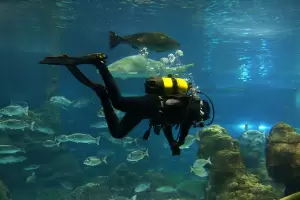
Lots of this work is done in a laboratory, but in order to study the ocean, a researcher must spend time in the water, on the water, or near the water. Some oceanographers learn to SCUBA dive, others spend time on a boat or in a submersible in order to collect data. Many oceanographers work at institutions around the world where they spend plenty of time lecturing or teaching about the ocean.
Obviously, many of the most reputable oceanographic institutions are located near the coastline. They pass on their knowledge to new student scientists who are training to become tomorrow's oceanographers.
Oceanography Salary & Compensation
According to the Bureau of Labor Statistics (BLS), the median pay for environmental scientists and specialists, which includes oceanographers, was $80,060 per year based on May 2024 data. The pay for geoscientists varies according to the industry of employment, with employees in the oil and gas extraction industry making the most, followed by federal government employees and engineering service employees.
| Percentile | Annual Salary |
|---|---|
| 10th Percentile | $50,130 |
| 25th Percentile | $62,090 |
| Median (50th) | $80,060 |
| Mean (Average) | $88,640 |
| 75th Percentile | $103,730 |
| 90th Percentile | $134,830 |
Source: Bureau of Labor Statistics (BLS), May 2024. Data for Environmental Scientists and Specialists, Including Health (SOC 19-2041), which includes oceanographers. Total employment: 84,930 positions.
What Is the Job Demand for Oceanographers?
According to the Bureau of Labor Statistics, the job market for geoscientists, including oceanographers, is expected to grow by 6% between 2022 and 2032, adding approximately 4,800 new positions. This growth rate is about as fast as the average for all occupations. The field is projected to have 6,900 annual job openings over the decade, including openings from workers who transfer to other occupations or exit the labor force.
Natural resource companies in the petroleum or gas industry are likely to provide a reliable source of employment for geoscientists, including oceanographers. Research and governmental institutes that work to provide environmental protection and water management will also contribute to the rise in demand for oceanographers.
An oceanographer can find work all over the planet, either with large governments, academic institutions, or a corporation. Even if oceanographers are based in one country, they may travel to new locales for various job duties. Related career paths include hydrologists, who study freshwater systems, and marine geologists who focus specifically on underwater geology.
How to Become an Oceanographer
Oceanographers usually receive a background education in biology, physics, chemistry, and geology, but they generally go on to focus their research within one field or the other. There are a few schools that offer undergraduate Bachelor's degrees in marine biology; however, most oceanographers further their studies before seeking work.
Usually, there are internships and assistant-level positions available for those with only undergraduate degrees. To get a more prominent position as an oceanographer, students usually go on to acquire a Master's or PhD level education before becoming ocean scientists. However, the undergraduate period allows a student to acquire experience in all the chemistry, biology, and physics basics that allow them to build upon their studies with more advanced topics in oceanography.
The typical career path follows this timeline: a four-year bachelor's degree in environmental science, marine biology, or a related field, followed by a master's degree (2-3 years) for most research positions, and a PhD (4-6 years) for senior research roles or academic positions. Throughout this education, hands-on experience through internships and fieldwork is essential for developing practical skills and professional connections.
Other Degrees Related to Oceanography
Professional Development & Organizations
Professional organizations provide valuable resources for oceanographers, including networking opportunities, research publications, and career development support.
- National Oceanic and Atmospheric Administration (NOAA), a United States government organization tasked with studying the atmosphere, ocean, and coasts and informing the citizens of the United States of their findings. This organization maintains a strong web presence and is a useful source of information regarding oceanic and atmospheric science and industry.
- Association for the Sciences of Limnology and Oceanography, a respectable foundation that furthers the cause of aquatic studies worldwide. This organization also contributes to public policy as well as education and outreach.
Other Recommended Resources
Frequently Asked Questions
What's the difference between an oceanographer and a marine biologist?
Marine biology is actually a specialization within the broader field of oceanography. While all marine biologists are oceanographers who focus specifically on ocean life and ecosystems, oceanographers may also specialize in other areas, including the ocean's chemistry, geology, or physical properties. An oceanographer might study ocean currents, seafloor tectonics, or water chemistry, while a marine biologist focuses exclusively on living organisms in marine environments.
Do I need a PhD to become an oceanographer?
Not necessarily. Entry-level positions and technician roles are available with a bachelor's degree, though opportunities may be limited. A master's degree opens up most research and applied oceanography positions. A PhD is typically required for senior research roles, university faculty positions, and leadership positions in research institutions. Your specific career goals will determine your educational needs.
Can oceanographers work in landlocked states?
Yes. While many oceanography positions are located near coastlines, oceanographers also work in landlocked locations at universities, government agencies, and research facilities. Some oceanographers travel to coastal areas or aboard research vessels for fieldwork, then return to inland laboratories to analyze data and write reports. Climate modeling and satellite data analysis can be performed anywhere.
What's the job outlook for oceanographers?
The field is projected to grow 6% from 2022 to 2032, adding approximately 4,800 positions with 6,900 annual job openings. Growth is driven by increasing concerns about climate change, ocean pollution, and sustainable resource management. Federal and state governments, research institutions, and environmental consulting firms continue to need qualified oceanographers.
How long does it take to become an oceanographer?
The timeline varies based on your career goals. For entry-level positions, you'll need a bachelor's degree (4 years) and potentially internships. Most research positions require a master's degree, adding 2-3 years. For senior research or academic positions, a PhD takes an additional 4-6 years. In total, expect 6-8 years for a master's-level career or 10-14 years for a PhD-level research position.
Key Takeaways
- Median salary: $80,060 annually for environmental scientists and specialists, which includes oceanographers (May 2024 BLS data).
- Job growth: 6% projected growth from 2022-2032, with approximately 4,800 new positions and 6,900 annual openings.
- Education requirements: Most positions require a master's degree; PhDs are preferred for senior research roles and academic positions.
- Four main specializations: Marine biology (ocean life), physical oceanography (water movement), chemical oceanography (water composition), and geological oceanography (seafloor).
- Work environment: Mix of laboratory research and fieldwork; may include SCUBA diving, research vessel work, and travel to coastal locations.
- Career preparation: Gain hands-on experience through environmental science degree programs with strong internship components and fieldwork opportunities.
Ready to explore oceanography programs? Find accredited environmental science degrees with marine and oceanography specializations that can launch your career studying Earth's oceans.

2024 US Bureau of Labor Statistics salary and job growth figures for Environmental Scientists and Specialists reflect state and national data, not school-specific information. Conditions in your area may vary. Data accessed January 2026. View the BLS Occupational Outlook Handbook.