
A sustainability degree prepares you to address environmental challenges while balancing economic and social factors across industries. Programs range from 2-year Associate's degrees to doctoral programs, with graduates pursuing careers as sustainability coordinators, environmental scientists, policy analysts, and corporate sustainability directors earning salaries from $45,000 for entry-level positions to $150,000+ for senior leadership roles.
If you're passionate about protecting the environment while driving business innovation, a sustainability degree might be the right fit for you. But with program options spanning from Associate's degrees to PhDs—and career paths ranging from corporate sustainability to environmental policy—how do you choose the path that aligns with your goals?
This guide breaks down everything you need to know about sustainability degrees, from understanding what sustainability really means to choosing between program levels, exploring career prospects, and finding the right school for your situation.
What Is Sustainability?
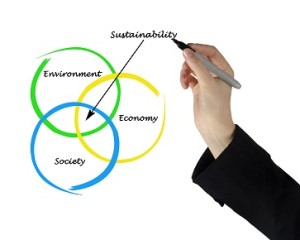
Sustainability combines environmental science, economics, business, and social systems to find balanced approaches that maintain or improve quality of life for future generations. At its core, sustainability focuses on minimizing environmental impacts caused by human activities while supporting economic growth and social wellbeing.
When you pursue a sustainability degree, you'll explore how businesses, governments, and communities can meet today's needs without compromising the resources future generations will depend on. This means studying everything from renewable energy systems and supply chain management to environmental policy and corporate social responsibility.
The field is truly interdisciplinary. You'll find sustainability principles applied across planning, agriculture, business, law, engineering, technology, environmental studies, biology, and more. This breadth means your degree can open doors across virtually every industry—from manufacturing and retail to government agencies and nonprofit organizations.
Why Study Sustainability? Career Prospects & Salary
The sustainability field has grown significantly over the past two decades. Today, sustainability professionals work in nearly every sector as consumers increasingly consider environmental impact when making purchasing decisions, and regulations continue connecting environmental, corporate, and financial performance.
Real Career Opportunities
Sustainability careers span a wide range of titles and responsibilities. Common positions include:
- Sustainability Coordinator - Entry to mid-level position implementing sustainability programs and tracking environmental metrics
- Sustainability Director - Senior leadership role developing organization-wide sustainability strategy
- Environmental Scientist - Research and analysis of environmental impacts and solutions
- LEED Professional - Specializing in green building certification and sustainable design
- Energy Manager - Optimizing energy use and implementing renewable energy systems
- Environmental Policy Analyst - Researching and developing environmental regulations and policies
- Environmental Engineer - Designing systems to protect environmental and human health
Salary Expectations
Environmental scientists and specialists, which includes many sustainability roles, earn a median annual salary of $76,480 according to 2022 Bureau of Labor Statistics data. However, your actual salary will depend heavily on your education level, specific role, industry, and location.
Typical salary ranges by position include:
- Sustainability Coordinators: $45,000-$65,000 (entry to mid-level with Bachelor's degrees)
- Environmental Scientists: $76,480 median (with strong science background and research skills)
- Policy Analysts: $64,950 median (requiring policy expertise and often graduate education)
- Corporate Sustainability Directors: $90,000-$150,000+ (senior leadership with Master's degrees and 10+ years experience)
Specialized roles like environmental lawyers and environmental chemists may command even higher salaries depending on their industry and expertise.
Job Growth & Outlook
The Bureau of Labor Statistics projects 6% growth for environmental scientists and specialists from 2022 to 2032, about as fast as the average for all occupations. Demand is particularly strong for professionals who can bridge technical environmental knowledge with business operations and policy development, as organizations increasingly prioritize environmental performance and regulatory compliance.


Understanding Sustainability Degree Levels
Sustainability programs are available at multiple degree levels, each serving different career goals and time commitments. Here's how they compare:
| Degree Level | Typical Duration | Credit Hours | Best For | Typical Cost Range |
|---|---|---|---|---|
| Associate's | 2 years | 60-70 credits | Entry-level positions, career exploration, transfer to bachelor's program | $10,000-$25,000 total |
| Bachelor's (BA/BS) | 4 years | 120 credits | Mid-level professional roles, career flexibility | $40,000-$120,000 total |
| Master's | 1-3 years | 30-45 credits | Advanced positions, career change, specialization | $20,000-$90,000 total |
| Doctoral (PhD) | 5-7 years | 60+ credits | Research, academia, senior policy positions | Often funded through fellowships |
| Certificate (Undergraduate) | 6-12 months | 12-18 credits | Adding specialization to existing degree, testing the field | $5,000-$15,000 total (estimated) |
| Certificate (Graduate) | 6-18 months | 12-18 credits | Professional development, pivoting from related field | $8,000-$25,000 total (estimated) |
Note: Costs vary significantly by institution type (public vs. private), residency status, and available financial aid. Ranges represent typical program costs as of 2024-2025 and should be verified with specific institutions.
Choosing the Right Sustainability Program for Your Goals
With hundreds of sustainability programs available nationwide, finding the right fit requires honest assessment of your situation and goals. Consider these questions:
Career Stage & Goals
- Are you starting your career, changing fields, or advancing in sustainability work you're already doing?
- Do you want a broad foundation or specialized expertise in areas like corporate sustainability, environmental policy, or green building?
- Are you more interested in hands-on implementation or high-level strategy and leadership?
Educational Background
- If you're pursuing sustainability as a second degree, certificates offer efficient specialization without repeating foundational coursework
- Students without prior environmental or business education typically benefit from comprehensive degree programs
- Consider dual degrees (like MBA in Sustainability and Compliance) if you need both business and environmental expertise
Time & Financial Constraints
- Can you commit to full-time study, or do you need part-time or online flexibility?
- What's your realistic timeline for entering the sustainability job market?
- Have you researched financial aid, scholarships, and employer tuition assistance?
Research or Practice Focus
- If you plan to pursue doctoral studies, choose Master's programs offering thesis or research options
- For immediate workforce entry, practice-oriented programs with internships or capstone projects may serve you better
Undergraduate Programs: Associates & Bachelor's Degrees
According to the Association for the Advancement of Sustainability in Higher Education (AASHE), hundreds of U.S. colleges offer undergraduate sustainability programs. Here's what you need to know about Associates and Bachelor's options.
Associate's Degrees in Sustainability
According to AASHE data, at least 33 schools nationwide offer 2-year Associate's degrees with sustainability focus, with 15 offering sustainability as a major and 18 offering minors. These programs provide solid foundations for entry-level sustainability work or transfer to Bachelor's programs.
Associate's programs typically combine core courses in environmental science, business fundamentals, and social sciences. You'll study topics like sustainable business practices, energy systems, basic chemistry and biology, and environmental ethics. The relatively low cost and short timeline make Associate's degrees ideal for exploring whether sustainability is right for you before committing to a 4-year program.
Bachelor's Degrees in Sustainability
AASHE reports approximately 421 colleges offer sustainability-focused Bachelor's degrees, with at least 98 programs specifically majoring in sustainability. You'll find both Bachelor of Arts (BA) and Bachelor of Science (BS) options, and the distinction matters.
For example, Arizona State University's BA focuses on "sustainability of environmental resources and social institutions" with stronger emphasis on policy, social systems, and humanities, while their BS focuses on "sustainable use of environmental resources" with more rigorous science, technology, and quantitative coursework. Check with individual programs to understand their specific BA versus BS distinctions.
Common Bachelor's coursework includes:
- Sustainable business and operations
- Environmental ethics and policy
- Energy systems and renewable energy
- Chemistry and biology fundamentals
- Environmental sociology and economics
- Data analysis and environmental modeling
- Supply chain sustainability
Many top environmental colleges offer dual-degree options combining Bachelor's and Master's degrees, potentially saving you time and money if you know you'll need graduate education for your target career.
Graduate Programs: Master's & Doctoral Degrees
Master's Degrees in Sustainability
According to AASHE, over 463 U.S. colleges offer Master's degrees with sustainability focus, with approximately 145 offering specific sustainability majors or concentrations. Master's programs typically require 1-3 years depending on full-time or part-time enrollment.
Graduate sustainability programs offer significantly more specialization than undergraduate degrees. You might focus on areas like:
- Corporate sustainability and ESG (Environmental, Social, Governance) reporting
- Environmental policy and regulation
- Sustainable supply chain management
- Green building and LEED certification
- Renewable energy systems and energy policy
- Urban sustainability and planning
- Climate change adaptation and mitigation
Many Master's programs offer both science/engineering tracks and social science/business tracks, allowing you to tailor your education to your career direction. The majority of students pursuing Master's degrees already hold Bachelor's degrees and want to advance from entry or mid-level positions into management and leadership roles.
Related graduate programs worth considering include Environmental Planning & Design, Environmental MBA, and specialized degrees in Energy Policy and Climate.
Doctoral (PhD) Programs in Sustainability
AASHE data indicates at least 103 colleges offer sustainability-focused doctoral programs, with several specifically in sustainability as a major. Doctoral programs typically require 5+ years and focus on original research contributing new knowledge to the field.
PhD programs prepare you for research positions, university faculty roles, and senior policy positions. You'll complete extensive coursework, comprehensive exams, original dissertation research, and typically teach undergraduate courses as part of your training.
Many doctoral programs offer full funding through fellowships, teaching assistantships, or research assistantships, making them more affordable than Master's programs despite the longer timeline. However, you're committing significant time before entering the workforce, so consider your long-term career goals carefully.
Certificates & Alternative Learning Pathways
Certificates offer flexible options for adding sustainability expertise to your existing qualifications or testing the field before committing to a full degree program.
Graduate Certificates
AASHE reports approximately 136 schools offer sustainability-focused graduate certificates, with about 61 specifically in sustainability. These programs typically require 12-18 credits (4-6 courses) and can often be completed in 6-18 months.
Graduate certificates work well if you:
- Already hold a Bachelor's or Master's degree in a related field
- Need specific sustainability credentials for career advancement
- Want to explore graduate-level sustainability coursework before committing to a full Master's program
- Work in a field increasingly requiring sustainability knowledge (architecture, engineering, business, etc.)
Undergraduate Certificates
According to AASHE, at least 51 colleges offer undergraduate sustainability certificates, with approximately half focusing specifically on sustainability. These programs offer a relatively low-risk way to determine if sustainability is the right field for you.
Common certificate coursework includes sustainable business, energy systems technology, environmental policy, and sociology of environmental issues.
Auditing Courses
Don't overlook the option to audit college courses. Auditing typically costs less than full enrollment since you won't receive official credit, but it exposes you to the subject matter, helps you gauge the level of effort required, and lets you experience teaching styles before committing to a program.
Online vs. Traditional Sustainability Programs
Online programs offer valuable flexibility for students whose employment makes attending traditional classes difficult, students living far from campus, or those needing to schedule coursework around other commitments.
While sustainability as a standalone discipline is relatively new and most programs traditionally operate in-person or hybrid formats, online options continue growing. Many schools now offer both traditional and online paths for the same degree, giving you flexibility to choose based on your circumstances.
Master's in Sustainable Management Online
Online Master's programs in Sustainable Management have become particularly popular for working professionals. These programs bridge scientific process with social implementation and action, preparing environmental advocates for systemic change.
Typical coursework includes:
- Cultural and Historical Foundations of Sustainability
- The Natural Environment
- Applied Research and the Triple Bottom Line
- Policy, Law, and the Ethics of Sustainability
- Statistical Methods in Sustainability
- Economics for Sustainable Development
Graduates move into careers in business services, manufacturing, trade and transportation, and environmental health and safety, with titles like Energy Analyst, Director of Global Environmental Affairs, Green Marketing Consultant, Sustainable Design Specialist, and Environmental Policy Analyst.
Schools offering online sustainable management programs include University of Wisconsin-Green Bay, Columbia University, Kogod School of Business at American University, National University, and Stevens Institute of Technology.
Costs & Financial Aid
Sustainability degree costs range significantly—from around $5,000 per year at community colleges to over $30,000 annually at private universities. Your actual cost depends on the institution, degree level, residency status (for public schools), and available financial aid.
Important factors to consider:
- Time to completion: Associate's degrees typically take 2 years, Bachelor's 4 years, Master's 1-3 years, and doctorates 5+ years
- Financial aid availability: Most accredited sustainability programs qualify for federal financial aid if you meet eligibility requirements
- Return on investment: Higher degrees generally lead to higher salaries, but also require more time before entering the workforce
- Online vs. traditional: Online programs may reduce costs related to housing and commuting, though tuition itself is often similar
Research scholarship opportunities specific to environmental and sustainability fields, and don't hesitate to contact program financial aid offices directly to understand your options.
Accreditation & Program Quality
Always verify that your chosen school holds proper accreditation. Most employers consider accreditation when evaluating degrees, and accreditation protects you by ensuring a neutral authority has reviewed and approved the school's coursework and objectives.
Accreditation also ensures consistency in coursework quality between degree and certificate options and allows you to transfer credits if you change schools or pursue additional education.
Look for regional accreditation (like Middle States, New England Association of Schools and Colleges, etc.) for the institution overall, and specialized accreditation where relevant (like ABET for engineering programs or AACSB for business programs).
School Spotlights & Example Programs
Here are examples of sustainability programs at different degree levels. Remember to verify current program details, costs, and requirements directly with schools, as information changes regularly.
Associate's Degree Example
Lane Community College (Eugene, OR)
Degree: Associate of Science Sustainability Coordinator
Program Focus: Sustainability Studies and Science
Study Options: Traditional
Website: https://www.lanecc.edu/science/sustainability-coordinator
Program Overview: This degree provides a solid foundation for students to begin careers in sustainability or enter Bachelor's degree programs.
Course Requirements: 93 credits consisting of 43 foundation and core credits plus 50 credits toward electives and career technical education.
Admission Requirements: High school transcripts or GED, placement testing, and advisor meeting.
Bachelor's Degree Examples
Arizona State University
Degree: Bachelor of Science in Sustainability
Program Focus: Sustainability Studies and Science
Study Options: Traditional and Online
Program Overview: Focuses on teaching a solid sustainability foundation while linking concepts to real-world problems.
University of South Dakota (Vermillion, SD)
Degree: Bachelor of Arts in Sustainability
Program Focus: Sustainability Studies and Science
Study Options: Traditional and Online
Website: https://www.usd.edu/arts-and-sciences/sustainability
Program Overview: Offers solid foundations for understanding current sustainability issues and problem-solving skills to address them.
Concentration Options: Natural sciences or social sciences
Course Requirements: 120 credits consisting of 53 core credits plus 67 credits toward electives, minor, and major.
Admission Requirements: ACT composite score of 21+ (SAT 990), GPA of at least 2.6, or rank in upper 50 percent of high school class.
Master's Degree Examples
Central Connecticut State University (New Britain, CT)
Degree: Master of Arts in Biological Sciences (Global Sustainability)
Program Focus: Sustainability Studies and Science
Study Options: Traditional and Online
Website: http://web.ccsu.edu/catalog/masterdegreeprograms/
Course Requirements: 30 credits toward the major.
Admission Requirements: Collegiate transcripts, personal statement, 3 letters of recommendation, and application for admission. GRE scores recommended but not required.
Ramapo College of New Jersey (Mahwah, NJ)
Degree: Master of Arts in Sustainability Studies
Program Focus: Sustainability Studies and Science
Study Options: Traditional and Online
Website: https://www.ramapo.edu/graduate/masus/
Program Overview: Combines natural sciences, social sciences, and business to help students identify problems and offer solutions advancing sustainability.
Concentration Options: Yes, multiple available
Course Requirements: 9 required courses toward major, with at least 18 courses offered in sustainability.
Admission Requirements: Collegiate transcripts, personal statement, 2 letters of recommendation, resume, and application. Interview available but not mandatory. GRE scores not required but accepted.
Doctoral Degree Example
Columbia University (New York, NY)
Degree: Doctoral Degree in Sustainable Development
Program Focus: Urban Studies and Planning
Study Options: Traditional
Website: https://sipa.columbia.edu/academics/programs/phd-sustainable-development
Program Overview: Provides skills necessary for students to pursue policy and research opportunities within sustainability.
Concentration Options: Up to 6 areas available
Course Requirements: 60 credits total including 10 core courses and 6 electives. Minimum 3.00 (B) average required for core classes. Students must participate in integrative seminars, complete thesis with oral exam, and present and defend dissertation. Active research and teaching requirement expected.
Admission Requirements: Successful completion of undergraduate degree with solid foundation in economics, mathematics, and science. High GRE scores required.
Funding: Full-tuition fellowships including stipends and health insurance available for all admitted students not already sponsored by governments, employers, or foundations.
Frequently Asked Questions
What is a sustainability degree?
A sustainability degree is an interdisciplinary program combining environmental science, business, economics, and social systems to prepare students for careers addressing environmental challenges while supporting economic growth and social wellbeing. Programs are available from Associate's through doctoral levels, with curricula covering topics like renewable energy, environmental policy, sustainable business operations, and supply chain management.
What can you do with a sustainability degree?
Sustainability degree graduates work across virtually every industry in roles like sustainability coordinator, environmental scientist, policy analyst, corporate sustainability director, energy manager, LEED professional, and environmental engineer. You'll find sustainability professionals in manufacturing, retail, technology, consulting, nonprofit organizations, government agencies, and corporate settings implementing environmental programs, developing policy, and driving sustainable business practices.
How long does it take to get a sustainability degree?
Degree completion time varies by level: Associate's degrees typically take 2 years, Bachelor's degrees 4 years, Master's degrees 1-3 years, and doctoral programs 5-7 years. Many schools offer accelerated or part-time options, and some provide dual-degree programs combining Bachelor's and Master's degrees in 5 years instead of 6.
How much does a sustainability degree cost?
Costs range from approximately $10,000-$25,000 total for Associate's degrees to $40,000-$120,000 for Bachelor's degrees, depending on whether you attend public or private institutions. Master's programs typically cost $20,000-$90,000, though many doctoral programs offer full funding through fellowships and assistantships. Actual costs vary significantly based on residency status, financial aid eligibility, and whether you attend online or traditional programs.
Is a sustainability degree worth it?
A sustainability degree can be worthwhile if you're passionate about environmental issues and interested in careers addressing climate change, resource conservation, and sustainable development. The field shows steady growth as organizations increasingly prioritize environmental performance and regulatory compliance. However, carefully consider your specific career goals, as some positions may require graduate degrees while others are accessible with Bachelor's degrees or certificates. Research salary expectations for your target roles and calculate your return on investment before committing.
What's the difference between a BA and BS in sustainability?
Bachelor of Arts (BA) programs typically emphasize social sciences, policy, humanities, and the social/cultural aspects of sustainability with fewer natural science requirements. Bachelor of Science (BS) programs focus more heavily on environmental science, technology, quantitative methods, and technical sustainability solutions with more rigorous math and science coursework. Choose based on whether you're more interested in policy and social change (BA) or technical and scientific approaches (BS). Check with individual programs as BA/BS distinctions vary by institution.
Can I get a sustainability degree online?
Yes, many schools now offer online sustainability degrees, particularly at the Master's level. While sustainability as a discipline is relatively new and traditionally offered in-person, online options continue growing. Many institutions provide both traditional and online formats for the same degree, giving you flexibility to choose based on your circumstances. Online programs work especially well for working professionals who need scheduling flexibility or live far from campus locations.
Key Takeaways
- Interdisciplinary Field: Sustainability combines environmental science, business, economics, and social systems, making graduates valuable across virtually every industry from corporate settings to government agencies.
- Multiple Degree Pathways: Programs range from 2-year Associate's degrees for entry-level work to doctoral programs for research and senior leadership, with certificates offering efficient specialization for career changers.
- Growing Career Opportunities: Sustainability professionals work as coordinators, directors, scientists, policy analysts, and engineers with salaries ranging from $45,000 for entry-level positions to $150,000+ for senior leadership roles.
- Education Matters for Advancement: Entry-level positions are often accessible with Bachelor's degrees, but Master's degrees typically open doors to management and leadership roles with significantly higher salaries.
- Specialization Options: Graduate programs allow focus in areas like corporate sustainability, environmental policy, renewable energy, green building, or sustainable supply chains aligned with your specific career interests.
- Flexible Learning Formats: Online and hybrid programs are increasingly available, particularly at graduate levels, making sustainability education accessible for working professionals and students far from campus locations.
Ready to explore sustainability degree programs that match your career goals? Whether you're starting your education or advancing your career, finding the right program is crucial to your success in this growing field.
Salary and job growth figures cited above are based on 2022 U.S. Bureau of Labor Statistics data for Environmental Scientists and Specialists, Including Health, which includes many sustainability-related occupations. Data reflects national averages and not school-specific information. Conditions in your area may vary. Data accessed January 2026.