
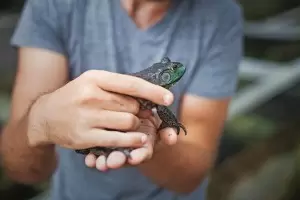
Herpetologists are zoologists who specialize in studying reptiles and amphibians including snakes, turtles, frogs, and salamanders. According to May 2024 BLS data, zoologists and wildlife biologists earned a median salary of $72,860, with employment projected to grow 2% from 2024 to 2034. Most positions require at least a bachelor's degree in biology, with research and academic roles requiring master's or doctoral degrees.
Herpetology is the branch of zoology focused on reptiles and amphibians—creatures like snakes, turtles, iguanas, frogs, and salamanders. This specialized field examines their behaviors, geographic ranges, physiologies, development, genetics, and ecological roles. A herpetologist is a zoologist who dedicates their career to understanding these fascinating animals, often focusing on conservation efforts or using them as indicators of broader environmental health.
What Does a Herpetologist Do?
Herpetologists study animals both in the wild and in controlled settings. In natural habitats, they assess potential threats from pollution, invasive species, disease, and climate change. They inventory populations, estimate numbers, and track behavioral patterns to understand ecological relationships and the challenges these species face.
Like other wildlife biologists, herpetologists play a critical role in ecosystem monitoring. Many reptiles and amphibians serve as indicator species—their presence, absence, or health status reveals important information about environmental conditions. This makes herpetological research valuable beyond the species themselves, offering insights into overall ecosystem health.
Field research focuses on understanding behavior, development, genetics, and distribution patterns. Herpetologists determine which ecological niches these animals fill, what ecosystem services they provide, and how human activities impact their survival. Many work closely with conservationists and policy makers to develop protection strategies for threatened species.
Conservation work represents a significant portion of herpetology careers. The field addresses urgent challenges facing species like American crocodiles, sea turtles, and numerous frog populations threatened by disease and climate change. Herpetologists plan and manage conservation programs, conduct environmental impact assessments for government agencies, and develop disease control strategies.
Research dissemination is essential to the profession. Herpetologists share findings through scientific journal articles and presentations at professional conferences. Many also engage in public education through programs at zoos, nature centers, and schools, helping communities understand the importance of reptiles and amphibians in our ecosystems.
Museum collection managers care for preserved specimens, cataloging and organizing them for research access. These positions typically require a master's degree in biology or museum studies. Zoo curators and supervisors hold administrative roles managing herpetology departments, coordinating educational programs, and overseeing animal care exclusively for reptiles and amphibians.
Where Does a Herpetologist Work?
Many herpetologists work as faculty members or research staff at colleges and universities, where they combine teaching with active research programs. Government agencies dealing with wildlife and environmental management employ others for field research and policy development. Museums offer opportunities working with exhibits, collections, and public programming, while zoos provide positions involving direct animal care and visitor education.
Industrial and medical biotechnology increasingly offer employment opportunities for biological researchers with herpetology expertise. Large environmental consulting firms hire herpetologists as specialists for impact assessments and compliance work. Some herpetologists teach biology in secondary schools, bringing their field expertise to younger students.
Work environments vary significantly based on research focus and career stage. Laboratory-based research studying developmental, anatomical, or genetic aspects of reptiles and amphibians happens in controlled settings with consistent conditions. Field research on species ecology, behavior, reproduction, and population biology requires extensive outdoor work. Many herpetology careers blend both laboratory analysis and field data collection, with the balance shifting based on your position, research questions, and career progression.
Field conditions can be challenging. You'll encounter strenuous physical demands, potentially isolating locations, and irregular hours—particularly when studying nocturnal species. Weather extremes, difficult terrain, and remote field sites are common aspects of herpetological fieldwork. As careers advance, some herpetologists transition toward more laboratory-focused or administrative roles, while others maintain active fieldwork throughout their careers.
What Is the Average Herpetologist Salary?
Herpetologists fall under the broader Bureau of Labor Statistics occupational category of zoologists and wildlife biologists (SOC code 19-1023). According to BLS data from May 2024, zoologists and wildlife biologists earned a median annual salary of $72,860. Earnings vary significantly based on employment sector, experience level, and educational credentials.
| Employment Sector | Median Annual Salary (2024) |
|---|---|
| Federal Government | $88,050 |
| Research and Development in Physical, Engineering, and Life Sciences | $76,860 |
| Management, Scientific, and Technical Consulting Services | $73,360 |
| State Government (excluding education and hospitals) | $69,900 |
Federal government positions typically offer the highest compensation, followed by private research and development organizations. Geographic location, specialized expertise in particular taxa, and advanced degrees also influence earning potential throughout your career. The lowest 10 percent of zoologists and wildlife biologists earned less than $48,240, while the highest 10 percent earned more than $113,350 in May 2024.
Herpetology Jobs & Job Description
Herpetologists study organisms within reptile and amphibian classifications. The focused scope of this specialization means job responsibilities share common elements across settings, though specific duties vary between field research, museum work, zoo positions, and academic roles.
Core responsibilities include:
- Providing excellent care for specimens under your stewardship
- Reviewing current research literature and scientific developments
- Organizing and maintaining exhibits
- Keeping animal enclosures properly maintained
- Managing ethical acquisition, disposition, transport, and acclimation of reptiles
- Caring for and feeding plants and animals in exhibit settings
- Participating in exhibit design and construction
- Representing your organization to the public
- Performing security protocols
- Planning strategically for reptile husbandry
- Assisting with venom extraction when working with venomous species
- Supporting veterinary medical care and laboratory work
- Maintaining clean, safe facilities
- Managing security, inventory, feeding, and husbandry databases
- Supporting documentation and record-keeping systems
- Developing improved data tracking systems
- Providing input for quality assurance and health and safety protocols
Senior herpetologists often assume leadership roles with additional responsibilities:
- Advising administrators and stakeholders on herpetological information
- Providing consultation to external agencies, professionals, and researchers
- Creating and delivering presentations, reports, and articles for various audiences
- Engaging in facility design and development
- Developing software programs for data collection and predictive modeling
- Planning, organizing, and participating in outreach and advocacy programs
- Constructing funding proposals and grant applications
- Overseeing team budgets, milestones, and operational systems
- Mentoring junior team members
- Establishing efficient workgroup systems
- Supporting colleagues' research initiatives
Career Progression in Herpetology
Herpetology careers typically follow distinct paths depending on educational attainment and professional goals:
Entry Level (Bachelor's Degree): Field technician positions, research assistantships, zoo keeper roles, and wildlife rehabilitation assistant positions provide hands-on experience with reptiles and amphibians. These roles offer excellent learning opportunities but typically require additional education for advancement.
Mid-Level (Master's Degree): Collections manager positions at museums, zoo curator roles, environmental consulting positions, and state wildlife biologist positions become accessible. These roles offer greater autonomy in research design, project management, and decision-making authority.
Senior Level (Doctoral Degree): University faculty positions, senior research scientist roles, conservation program director positions, and museum curator positions represent the pinnacle of herpetology careers. These roles involve leading research teams, securing competitive grant funding, publishing original research, and shaping the direction of the field.
What Is the Job Demand for Herpetologists?
Employment for zoologists and wildlife biologists is projected to grow 2% from 2024 to 2034, which is slower than the average for all occupations. Despite limited employment growth, approximately 1,400 job openings for zoologists and wildlife biologists are projected each year on average over the decade. Most openings will result from the need to replace workers who transfer to different occupations or retire, rather than from new position creation.
Given the limited number of funded positions and slow job growth, competition for herpetology roles remains intense. The specialized nature of the field, combined with constrained funding for wildlife research, means qualified candidates significantly outnumber available positions. You'll need to distinguish yourself through practical experience, strong academic credentials, and demonstrated research capabilities.
Candidates with practical experience gained through volunteer work at zoos, wildlife rehabilitation centers, and nonprofit conservation organizations have the best employment prospects. Internships, field research participation during undergraduate or graduate studies, and published research contributions strengthen your competitiveness in this challenging job market.
Essential Skills for Herpetologists
Success as a herpetologist requires combining scientific knowledge with practical field skills and personal attributes that help you thrive in challenging research conditions.
Technical Skills
Core competencies you'll need to develop include:
- Species identification and taxonomic classification
- Field survey techniques and population sampling methods
- Data collection protocols and statistical analysis using R or similar software
- Geographic Information Systems (GIS) for spatial analysis and habitat modeling
- Environmental DNA (eDNA) techniques for species detection
- Remote sensing applications for habitat assessment
- Laboratory techniques for genetics, anatomy, or physiology work
- Scientific writing and research documentation
- Grant writing and proposal development
- Database management for specimen records
Physical Requirements
Field herpetology can be physically demanding. You'll need comfort working outdoors in various weather conditions, the ability to hike through challenging terrain, and the willingness to work irregular hours, including nights, when studying nocturnal species. Physical stamina for extended field sessions and the ability to work in remote, sometimes uncomfortable conditions are essential.
Personal Attributes
Patience and meticulous attention to detail prove critical for long-term field studies that may require months or years to yield results. Strong communication skills help whether you're writing research papers, presenting findings at conferences, or educating the public about conservation issues. Adaptability, problem-solving abilities, and genuine passion for understanding these often-misunderstood animals sustain you through the challenges of this competitive field.
How Do I Get a Herpetologist Degree?
Nearly all herpetology positions require at least a bachelor's degree in biology, zoology, or a closely related field. A few universities offer specialized undergraduate programs in herpetology or wildlife biology with herpetology concentrations, but these remain rare. Most students pursue broad biology majors and gain specialization through strategic coursework, research experiences, and graduate education.
Undergraduate Preparation
Your bachelor's program should include comprehensive biology coursework covering anatomy, physiology, ecology, evolution, and genetics. Consider programs offering zoology degrees or strong wildlife biology tracks.
Essential coursework includes:
- General biology and zoology
- Vertebrate anatomy and physiology
- Ecology and population biology
- Herpetology (if offered) or vertebrate zoology
- Evolution and genetics
- General and organic chemistry
- Physics and calculus
- Statistics and research methods
- Animal behavior
- Conservation biology
During your undergraduate years, actively seek field experience through summer research programs, internships at zoos or nature centers, or volunteer work with conservation organizations. These experiences prove crucial for graduate school applications and future employment. Many successful herpetologists credit undergraduate field experiences as pivotal in developing their research skills and professional networks.
Graduate Education
Most research positions and all faculty positions at colleges and universities require graduate degrees. Master's programs typically span 2-3 years and focus on developing research skills through a thesis project investigating a specific question in herpetology. These programs prepare you for mid-level positions in conservation, consulting, and applied research.
Doctoral programs require 4-6 years beyond the bachelor's degree and prepare you for independent research and teaching. PhD graduates pursue faculty positions, lead research programs, and contribute original scientific knowledge to the field. The dissertation represents substantial original research advancing understanding in your specialized area.
When selecting graduate programs, carefully evaluate faculty members conducting active research in your area of interest. Your graduate advisor's research focus, funding sources, and professional network significantly influence your career opportunities after graduation. Visit prospective programs, meet with potential advisors, and talk with current graduate students about their experiences.
Alternative Pathways
If you're considering herpetology but don't have a biology degree, you'll likely need to complete prerequisite coursework before applying to graduate programs. Some universities offer post-baccalaureate programs specifically designed for career changers seeking to enter the biological sciences.
Knowledge of foreign languages can open valuable opportunities for international fieldwork and research collaborations. Spanish or Portuguese proficiency particularly benefits work in Central and South America, regions hosting exceptional reptile and amphibian diversity. Many significant herpetological discoveries and conservation efforts occur in these biodiversity hotspots.
Licensing and Certification
Licensure is not typically required for herpetologists. However, specific credentials may be beneficial or required depending on your work setting. Environmental consultants working on projects requiring regulatory compliance may need professional certifications. Government positions may require specific civil service qualifications or clearances. Some states require permits for handling certain protected species, which are typically obtained through your employer rather than as individual professional licenses.
Related Degree Options for Herpetologists
Consider exploring fish and wildlife management programs, environmental biology programs, or related biological science degrees that provide a strong foundation for herpetology specialization.
What Kind of Societies and Professional Organizations Do Herpetologists Have?
- The American Society of Ichthyologists and Herpetologists is an international professional organization dedicated to studying and conserving fishes, amphibians, and reptiles. It organizes annual meetings and symposia, publishes the scientific journal Copeia, and hosts a job board connecting members with opportunities.
- The Society for the Study of Amphibians and Reptiles is the largest international herpetological society with a strong conservation focus. It offers diverse publications, meetings, and symposia. The society also hosts a comprehensive list of regional herpetology societies worldwide and provides manuscript review services for members developing publications.
Frequently Asked Questions
What's the difference between a herpetologist and a zoologist?
A herpetologist is a type of zoologist who specializes specifically in reptiles and amphibians. While zoologists study all animal life broadly, herpetologists focus their research, conservation efforts, and expertise on frogs, salamanders, snakes, turtles, lizards, and crocodilians. This specialization requires deep knowledge of these particular taxa and their unique biological characteristics.
Can I become a herpetologist with just a bachelor's degree?
Entry-level positions in herpetology are possible with a bachelor's degree in biology or a related field. These typically include field technician roles, zookeeper positions, or research assistant positions. However, most independent research positions, university faculty roles, and senior conservation positions require a master's degree or PhD in biology, zoology, or herpetology with a strong research background.
Do herpetologists work primarily in the field or in laboratories?
It depends on your specialization and research focus. Field herpetologists spend significant time outdoors studying animals in their natural habitats, often working in challenging environmental conditions. Laboratory-based herpetologists focus on genetics, development, anatomical research, or toxicology studies. Many positions involve both field data collection and laboratory analysis, requiring versatility across different research settings.
What's the job outlook for herpetologists?
Employment for zoologists and wildlife biologists, including herpetologists, is projected to grow 2% from 2024 to 2034, which is slower than average for all occupations. Despite limited growth, approximately 1,400 annual job openings are projected over the decade. Competition remains intense for available positions. Candidates with practical field experience, volunteer work at zoos or rehabilitation centers, published research, and strong academic credentials have the best opportunities in this competitive field.
Can herpetologists work with venomous snakes?
Some herpetologists do work with venomous species, particularly in zoo settings, research facilities, or conservation programs focused on these animals. This specialized work requires extensive training in safe handling protocols, an understanding of venom properties, and often involves assisting with venom extraction for medical research, providing veterinary care, and developing safety procedures for managing these dangerous animals responsibly.
Key Takeaways
- Specialized Biological Field: Herpetology focuses specifically on reptiles and amphibians, requiring deep knowledge of these taxa and often extensive field research experience in diverse environmental conditions.
- Education Requirements: Entry-level positions require at a minimum a bachelor's degree in biology or zoology, while research positions and academic roles typically require master's or doctoral degrees with strong publication records.
- Competitive Employment Landscape: With projected job growth of 2% from 2024 to 2034 (slower than average) and approximately 1,400 annual job openings nationwide, practical experience through internships, volunteer work, and field research proves essential for employment success.
- Diverse Work Settings: Herpetologists work in universities, government agencies, museums, zoos, environmental consulting firms, and biotechnology companies, with responsibilities ranging from field research to public education and careers often blending laboratory and field components.
- Conservation Focus: Many herpetologists dedicate their careers to conserving threatened species like sea turtles and amphibians facing disease and climate change, using these animals as indicators of broader ecosystem health.
Ready to begin your journey in herpetology? Explore biology and zoology degree programs that offer specializations in wildlife biology and conservation.
2024 US Bureau of Labor Statistics salary and job growth figures for zoologists and wildlife biologists reflect national data, not school-specific information. Conditions in your area may vary. Data accessed February 2026.