

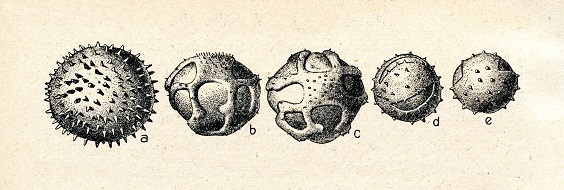
Palynology is the scientific study of microscopic organic materials like pollen, spores, and dinoflagellates preserved in sediments and rocks. This interdisciplinary method helps researchers understand past climates, track environmental changes, identify archaeological sites, and reconstruct ancient landscapes. Palynologists work across botany, geology, archaeology, and climate science to unlock Earth's environmental history.
Understanding how landscapes and climates have changed over time is one of environmental science's most fascinating challenges. If you're drawn to detective work on a microscopic scale—uncovering evidence of ancient forests, tracking climate shifts, or helping archaeologists piece together human history—palynology might be exactly what you're looking for.
Palynology—the study of microorganic material such as spores, pollen, dinoflagellates, and microfossils—is a method employed across multiple environmental disciplines. While it's not typically offered as an undergraduate major due to its specialized nature, students from botany, plant biology, chemistry, environmental studies, archaeology, geography, and Earth Sciences find their way into this field, making it one of the most diverse fields in environmental research.
Here's what makes palynology so compelling: landscapes are constantly changing. We can learn about past climates, natural processes, and human impacts by studying the tiniest remains of plant life. Flora—trees, flowers, grasses, mosses, lichens, and fungi—thrive under specific environmental conditions and struggle in others. When climates shift from dry to wet, temperate to glacial, or when tidal salt marshes become pasture, the plant communities change dramatically. These changes leave microscopic evidence that trained palynologists can read like a history book.
One of the most useful extant remains of a plant that will survive under certain conditions is its pollen or spores. These are the elements of the plant used for sexual reproduction during the spring season. We call this study of pollen and spores pollen analysis. Palynology, though, looks at other evidence types such as microscopic marine life, microfossils, and other minute organic samples.
Pollen and spores do not survive in all conditions all of the time. Though they are hardier than the plants that grow from them, generally we get most of our surviving material (in temperate regions at least) when we dig it up from waterlogged soil. Some of the best surviving examples of spores and pollen have come from the bottoms of rivers and lakes. They are most common in areas where there is, or once was, a high water table and anaerobic conditions have protected them from the elements. What we know from the study of pollen and spores is dictated not only by conditions but also by the fact that the sheer weight of numbers during the pollen season leaves us with no evidence at all.
Whether using sexual reproduction, photosynthesis, or parasitism, microscopic marine life forms such as plankton are also a major evidence type in palynology. Like pollen and spores, they survive best in waterlogged soils, and fossilized samples are best acquired from dried-up sea and riverbeds.
Table of Contents
- A Brief History
- The Evidence of Palynology
- Applications: What They Can Tell Us
- Frequently Asked Questions
- Key Takeaways
A Brief History
Microscopic plant remains have been studied since the mid-17th century. Nehemiah Grew, practically the inventor of plant physiology, was among the first to recognize that pollen was essential for plant reproduction. The invention of the microscope in the same century made detailed study possible and remains the essential tool for this work today.
The oil industry first recognized palynology's commercial potential in the early 1900s, realizing that organic inclusions in geological layers could help locate oil deposits. The field became truly scientific when Swedish researcher Lennart von Post developed quantitative methods for calculating pollen survival rates in peat bogs. This mathematical approach revolutionized the understanding of Ice Age vegetation and climate relationships.
Researchers found that in Ice Age Europe, birch and pine were amongst the first tree species to recolonize the soils, with pine making an aggressive invasion to replace birch in some areas, meaning rainfall had dropped.
Despite this growth of study, the word "palynology" was not introduced until the end of World War II when the fledgling science of studying tiny organisms was finally given its name. The word "palynology" has been adapted from a Greek word that means "strewn" or "sprinkled". Thus, palynology is the study of small, sprinkled things.
The Evidence of Palynology
So what sort of things does palynology look at? All materials used in palynology are referred to as palynomorphs. They are organic materials too small to see with the naked eye; anything that is a palynomorph will come under palynology. The scientific definition of a palynomorph is "an organic-walled microfossil 5 to 500 micrometres in size".
Pollen: This is the most common evidence type and the one that comes immediately to mind when we talk about palynology. First appearing in the fossil record over 300 million years ago, their evolution has been a boon for human understanding of the development and colonisation by plant species. During the spring season, a plant that uses pollen for reproduction may use one of two methods to propagate itself.
- Wind: a male part of a plant releases thousands upon thousands of pollen and lets nature take its course by carrying it on the wind until it meets with the female part of another plant. This method requires a lot of energy expenditure on the part of the plant. The air can often be dense with pollen, hence so many people suffer from hay fever during the peak of spring. Typically, this type of pollen is light, though it has a shell; it will not be as hard or as heavy as the second type. It is also very abundant, as the wind will carry it in all directions and lay it evenly around a landscape. Most of the pollen studies in palynology will come from wind-blown pollen
- Insect: Some plants have another route through which to distribute their pollen, using the available animals such as bees, butterflies, and other pollinating insects. It doesn't need to blow out tonnes of pollen every day because insects come to it, feed on the nectar, and the pollen gets stuck to their bodies and transferred to another plant when it visits a neighbour. This is often much heavier than wind-blown pollen, and because of the more limited distribution, we have to look in other places for this type of evidence, from the bodies of dead or trapped insects (modern and ancient) or from extant honey residue.
Spores: Specific to moss and fungi such as mushrooms and toadstools, these travel the landscape in more or less the same way that wind-blown pollen gets about. This also means that it survives in more or less the same places that wind-blown pollen survives in. The walls of the pollen and the spore are remarkably similar, so many of the concepts behind the study of each will be the same, too. What is likely, though, is that spores represent the first method by which marine plant life took hold on land. Some may have been distributed through water and took hold in soil as waters retreated (tidal, for example). This is still the case for marine plant species that still use spores, but like their land-based plant brothers and sisters, they have also evolved to be carried on the wind.
Dinoflagellates: These single-cell organisms survive in the ocean. They are quite remarkable, and though they serve a different function to pollen and spores (they are a life form in themselves – some reproduce sexually, others asexually, others still through photosynthesis, with some that are parasitic), they also fall under the flag of palynology. They live on sunlight and often are the primary food source for most forms of marine life – so abundant are they that at certain times of the year we see ocean blooms; plankton is arguably the best-known type of dinoflagellate.
Applications: What They Can Tell Us
Now that we have established the primary evidence types, we need to look at precisely what it is that palynology can tell us. There is a wealth of information available for many disciplines. It's one of the scientific tools for a cross-disciplinary approach to environmental studies.
Geology: We mentioned above that it was the oil industry that first noticed the benefits of palynology as a commercial application for identifying pockets of oil. Certain microfossils survive better in certain types of rock, and those that are correlated regularly with oil pockets are a great way of prospecting for new pockets; they are abundant in certain types of rock, so they act as a great indicator. They may also be used for dating rocks, as most of the rocks in which these fossils are found are sedimentary, meaning they were once a river or sea bed, much like how pollen, spores, and dinoflagellates survive today.
The Palaeoenvironment: Climate change is largely concerned today with how human activity is changing the environment. In the distant past, climate change was overwhelmingly a natural process subject to all the natural forcings that we know about now, and despite that, much of the discussion is on anthropogenic climate change; it is important to know the difference as well as understand what factors drive natural processes. In order to understand how we might be affecting the climate, and what effect such elements as greenhouse gases have on the global and local environments, land and sea, we can say with certainty that it is necessary to look to the distant past – periods of cold and warm. How did the changes of the past affect plant and animal life? What were the knock-on effects? Local extinctions? Invasive species? How did the glacial retreat affect the topography and vegetation? For example, we have a good chronology of the retreat of the glaciers in Quebec and how tree species changed as the climate altered.
Geoengineering/geoarchaeology: As well as looking at how natural processes affect the climate, we also use the evidence to look at how human action has changed the topography over time. With 250,000 years of human history, there is much about our prehistoric past we still do not know, as really only organic material will survive under certain circumstances; therefore, the record is limited even though we have learnt so much from what we do have. Palynology has many applications in archaeology, and pollen analysis has been core to tracking the spread of the Neolithic Revolution, for example, particularly for the selective breeding of plants such as wheat, barley, and other grains. In Bohemia, where conditions have been poor in the past, researchers have been able to draw up a 5000 year long vegetation history through pollen studies alone.
Forensic Applications: Modern palynology includes forensic applications, where palynologists analyze pollen evidence from crime scenes to establish locations and timelines.
Human diet: Related to studies of the human environment and geoarchaeology, we now understand many aspects of the day-to-day living of people who lived in a time when there was no writing. Particularly, we have learnt much from the study of the stomach contents from bodies retrieved from such places as bogs. Stomach contents are often preserved, and as the diet would have been largely vegetarian, the organic material we are able to extract from their guts is a vital source of understanding what a typical diet might have been in a certain area. It's not just from the bodies either; we also examine human and animal feces and residues from ancient artifacts such as stone tools and pottery.
Related Disciplines: Palynology connects closely with phytoliths study—the analysis of microscopic plant silica structures that complement pollen evidence in reconstructing ancient environments.
Frequently Asked Questions
What educational background do I need to work in palynology?
Most palynologists come from undergraduate programs in botany, geology, environmental science, archaeology, or biology. Since it's rarely offered as a standalone major, you'll typically specialize in palynology during graduate school while building foundational knowledge in plant biology, microscopy, and research methods.
Where do palynologists find employment?
Career opportunities exist in oil and gas companies, environmental consulting firms, museums, universities, government agencies (like the EPA or USGS), and archaeological research organizations. Some palynologists work as independent forensic consultants.
What's the difference between palynology and phytolith analysis?
Palynology studies organic microfossils like pollen and spores, while phytolith analysis examines inorganic silica structures from plants. Both techniques complement each other in reconstructing ancient environments, as they preserve under different conditions and provide different types of information.
How do palynological samples survive for thousands of years?
Pollen and spores have remarkably durable outer walls that resist decay. They survive best in waterlogged, anaerobic environments like lake bottoms, peat bogs, and river sediments, where oxygen levels are too low for decomposition bacteria to break them down.
Can palynology be used to study recent environmental changes?
Absolutely. Modern palynological techniques can track vegetation changes from the Industrial Revolution, document pollution impacts on plant communities, and monitor ecosystem responses to current climate change. Lake sediment cores provide year-by-year records of environmental conditions.
Key Takeaways
- Interdisciplinary Tool: Palynology serves botany, geology, archaeology, climate science, and forensics through microscopic plant evidence analysis.
- Ancient Climate Detective: Pollen and spores preserved in sediments reveal past environmental conditions, helping scientists understand natural climate patterns and ecosystem changes.
- Diverse Career Paths: Professionals work in oil exploration, environmental consulting, museums, universities, government agencies, and forensic investigation.
- Specialized Graduate Training: While undergraduate programs in related sciences provide a foundation, most palynologists specialize during graduate school through research experience.
- Practical Applications: Beyond academic research, palynology supports oil exploration, archaeological site interpretation, environmental impact assessment, and legal investigations.
Ready to explore a career that combines scientific detective work with environmental research? Discover the educational path and career opportunities in palynology.

- What Is Parasitology? The Science of Parasites Explained - November 19, 2018
- Desert Ecosystems: Types, Ecology, and Global Importance - November 19, 2018
- Conservation: History and Future - September 14, 2018
Related Articles


Featured Article