

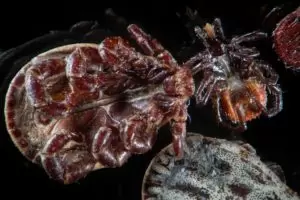
A parasitologist studies the life cycles, biology, and ecology of parasites and their relationships with host organisms. While not separately tracked by the Bureau of Labor Statistics, parasitologists working in related fields such as environmental science, microbiology, or biological research earned median salaries ranging from $80,000 to $89,000 as of May 2024. The field combines laboratory research, genetics, and ecological study to understand and control parasitic diseases.
Parasitologists study parasites in ways that most people never consider. From the tiny varroa mite threatening honeybee colonies to flatworms living in human digestive systems, these scientists investigate how parasites survive, reproduce, and impact their hosts. It's a field that touches everything from public health to agricultural productivity to ecosystem balance. If you're drawn to the intersection of microbiology, ecology, and real-world problem-solving, parasitology offers a unique career path worth exploring.
What Does a Parasitologist Do?
Parasitologists study parasites and their life cycles, reproduction patterns, and biological characteristics. Some also examine microbiology of bacteria and viruses, though this is typically the domain of virologists and bacteriologists in medical research settings. A parasite depends on other organisms as hosts and cannot survive or reproduce without them. Parasitologists study species that require another species as part of their life cycle.
What surprises many students is that parasitic life actually outnumbers free-living species. Parasites exist in every living species, both animals and plants. From the varroa mite, thought responsible for Colony Collapse Disorder in bees, to flatworms infesting human stomachs, they're everywhere, and many have received little study.
Parasitology examines the ongoing relationship between host and parasite. This relationship matters for ecology and environmental health. Where parasitologists work depends on their specialization. They may work in medical research, finding ways to build tolerance to parasites and developing vaccines and treatments. They may examine parasites' genetic structure, with applications across multiple fields. Sometimes we harness parasites to control harmful species, protecting agriculture. Parasitologists have made significant contributions to how our world works.
Where Does a Parasitologist Work?
Parasitologists work across several distinct fields. The majority work in medical research, where pharmaceutical companies and university research departments hire most graduates. They typically study parasite life cycles, either to understand how they function or develop new treatments for the diseases they cause. Sometimes their genetics help develop treatments for diseases unrelated to the parasite itself.
The second central area is agriculture and veterinary medicine. These parasitologists indirectly focus on human health. Parasites living on livestock like cattle, sheep, and fish can devastate agricultural production and threaten human health. An equally extensive number of people work in fisheries alongside aquatic ecologists. These veterinary parasitologists control the spread of parasites through animal populations, protecting food supplies and economic stability.
The third area is ecological parasitology. How do parasites function in their environment? How do they stay dormant without hosts? How do they spread and infect new hosts? Understanding parasite ecology helps us understand environmental change. Like entomology, parasitology can serve as an indicator of environmental shifts and ecosystem health.
Parasitologist Salary & Compensation
Parasitologists are not tracked as a separate occupation by the Bureau of Labor Statistics, so salary data must be analyzed across related occupational categories. Depending on their specialization and work setting, parasitologists may be classified as environmental scientists, microbiologists, or biological scientists.
As of May 2024, professionals in these related fields earned the following median salaries:
| Occupational Category | Median Annual Salary | Typical Parasitology Roles |
|---|---|---|
| Environmental Scientists and Specialists | $80,060 | Ecological parasitologists, field researchers |
| Microbiologists | $84,400 | Medical parasitologists, laboratory researchers |
| Biological Scientists (All Other) | $88,650 | Research scientists, academic positions |
Salary ranges vary significantly across these categories. Environmental scientists typically earn between $50,130 (entry-level) and $134,830 (senior positions), while microbiologists earn between $48,330 and $133,080. Your specific salary as a parasitologist depends on your specialization, education level, work sector, and geographic location.
Work setting influences compensation considerably. Pharmaceutical research and federal government positions typically offer higher salaries, while academic and nonprofit roles may pay less but provide research autonomy and teaching opportunities.
Parasitology Jobs & Job Description
A parasitologist's job description varies based on specific role and sector, but entry-level positions typically include these responsibilities:
- Isolate and maintain cultures of parasites in prescribed or developed media, controlling moisture, aeration, temperature, and nutrition
- Study growth, structure, development, and general characteristics of parasites to understand their relationship to human, plant, and animal life
- Examine physiological, morphological, and cultural characteristics using microscopes and other laboratory tools
- Maintain and calibrate microscopes and other laboratory equipment used in studying parasites
- Develop working knowledge of specialized equipment such as electron microscopes, gas and liquid chromatographs, electrophoresis units, and thermocyclers
- Observe and record the action of parasites upon living tissues of plants, animals, and other microorganisms
Experienced parasitologists add project management duties to their responsibilities:
- Supervise biological technologists and other scientists
- Develop research goals and lead data collection and analysis processes
- Prepare technical reports and recommendations based on research outcomes
- Supervise laboratory facilities and ensure the quality and efficiency of research projects
Skills Required to Become a Parasitologist
Success as a parasitologist requires both technical expertise and analytical capabilities. We've found these skills consistently matter most:
- Laboratory Techniques: Proficiency with microscopy, cell culture, specimen preparation, and sterile technique
- Analytical Thinking: Ability to design experiments, interpret complex data, and identify patterns in biological systems
- Attention to Detail: Precision in measurements, observations, and documentation of research findings
- Scientific Writing: Clear communication of research methods, results, and conclusions in technical papers
- Problem-Solving: Creative approaches to research challenges and experimental troubleshooting
- Data Analysis: Statistical software proficiency and computational modeling skills
- Biology Knowledge: Strong foundation in genetics, cell biology, immunology, and ecology
- Collaboration: Working effectively with interdisciplinary research teams and mentoring junior scientists
What Is the Job Demand for Parasitologists?
Because parasitologists aren't tracked separately by the Bureau of Labor Statistics, job outlook data comes from related occupational categories. The projections vary depending on which category most closely matches your specialization:
Environmental Scientists and Specialists: Projected 6 percent growth between 2022 and 2032, adding approximately 4,800 positions with 6,900 average annual openings.
Microbiologists: Projected 5 percent growth between 2022 and 2032, adding approximately 1,700 positions with 2,000 average annual openings.
Several factors influence demand for parasitology specialists. Federal government budget constraints have affected some research positions, as government agencies historically employed many parasitologists. However, pharmaceutical companies are expanding their search for new treatments, particularly as antibiotic-resistant pathogens create urgent needs for alternative approaches. Parasite genetics may offer solutions that traditional antibiotics cannot provide.
Geographic variation matters significantly. Regions with strong agricultural sectors, major research universities, or pharmaceutical presence tend to offer more opportunities. Coastal areas with active fisheries also employ parasitologists to monitor and control disease in aquaculture operations.
What Are the Education Requirements to Become a Parasitologist?
High school students interested in parasitology should focus on strong grades in mathematics, chemistry, and biology. Computer science and statistical skills have become increasingly important as research increasingly relies on computational power and big data applications.
Bachelor's degree programs in parasitology exist but remain relatively rare. Microbiology offers a more widely available foundation. Students wishing to specialize in a particular area, such as environmental parasitology, should seek schools that offer these options as minors. Otherwise, pursuing a Master of Science or Doctor of Medicine is the path forward, with PhD programs offering the deepest specialization.
Most bachelor's programs involve laboratory or field work through internships. This practical experience proves fundamental for future study and career advancement. Take these opportunities when offered. Students with a master's degree typically find suitable work in most fields that require these skills. If you want to work primarily in research and laboratory settings, a master's degree should suffice. However, higher-level research roles and teaching positions, especially in universities or specialized schools, require a doctorate.
Parasitology - Related Degrees
What Kind of Societies and Professional Organizations Do Parasitologists Have?
Parasitology is an important area of the life sciences beyond medical research. Here are some of the best-known organizations:
- World Federation of Parasitologists: Promoting international information exchange, the WFP holds a conference every four years to ensure researchers collaborate for the advancement of the science
- American Society of Parasitologists: The most prominent organization dedicated to parasitology in the United States, with 800 members nationwide representing medical researchers, industry specialists, and ecologists
- American Association of Veterinary Parasitologists: AAVP works to protect wild species from parasites and ensure agricultural livestock remain safe for the environment and human use
Frequently Asked Questions
What does a parasitologist do daily?
Parasitologists spend their days culturing and maintaining parasite specimens, examining samples under microscopes, recording observations of host-parasite interactions, and analyzing data from experiments. They maintain specialized laboratory equipment, prepare technical reports, and collaborate with other scientists. Senior parasitologists also supervise research teams, design experiments, and write papers for publication in scientific journals.
How much do parasitologists make?
Parasitologists are not tracked separately by the Bureau of Labor Statistics, so salary data comes from related fields. As of May 2024, environmental scientists earned a median of $80,060, microbiologists earned $84,400, and biological scientists earned $88,650. Your actual salary as a parasitologist depends on your specialization, with medical research positions often falling under microbiology categories and ecological positions under environmental science. Entry-level positions typically start around $48,000 to $50,000, while experienced researchers can earn $103,000 to $134,000.
What degree do you need to become a parasitologist?
Most parasitology positions require at least a bachelor's degree in microbiology, biology, or a related field. A master's degree opens more career opportunities and is sufficient for many laboratory and research positions. However, leading research projects, teaching at the university level, or directing laboratory facilities typically requires a PhD in parasitology, microbiology, or environmental science.
Is parasitology part of microbiology?
Parasitology and microbiology are closely related but distinct fields. Parasitology specifically focuses on parasites and their relationships with host organisms, while microbiology more broadly studies all microorganisms, including bacteria, viruses, fungi, and parasites. Many parasitologists have microbiology training, and the fields overlap significantly in methods and applications, particularly in medical research.
What is the job outlook for parasitologists?
Job outlook for parasitologists depends on which occupational category best matches your specialization. Environmental scientists (including ecological parasitologists) are projected to grow by 6 percent through 2032, while microbiologists (including medical parasitologists) are projected to grow by 5 percent. Both fields offer steady demand, with pharmaceutical companies expanding research into parasite genetics and agricultural sectors seeking specialists to protect livestock and crops from parasitic diseases.
Key Takeaways
- Varied Salary Ranges: Parasitologists earn median salaries between $80,060 and $88,650, depending on their specialization area, with BLS tracking them under environmental scientists, microbiologists, or biological scientists rather than as a separate occupation.
- Steady Job Growth: Related fields are projected to add 5 to 6 percent employment growth through 2032, with environmental scientists adding 4,800 positions and microbiologists adding 1,700, creating consistent opportunities across specializations.
- Multiple Education Pathways: While bachelor's degrees provide entry-level access, most positions require a master's degree, and research leadership or university teaching demands a PhD in parasitology, microbiology, or related fields.
- Diverse Work Environments: Parasitologists work in medical research, pharmaceutical development, agricultural protection, fisheries management, and ecological research, offering varied career paths based on personal interests.
- Specialization Opportunities: The field allows focus on medical parasitology, veterinary parasitology, or ecological parasitology, each addressing different aspects of host-parasite relationships and real-world applications.
Ready to explore parasitology programs? Discover degree programs in microbiology, environmental science, and related fields that can launch your career studying parasites and their impact on health and ecosystems.

2024 US Bureau of Labor Statistics salary and job growth figures reflect data for Environmental Scientists and Specialists and Microbiologists. Parasitologists are not tracked as a separate occupation and may be classified under multiple categories depending on their work setting. All figures reflect national data, not school-specific information. Conditions in your area may vary. Data accessed January 2026.