


Cultural resources—including archaeological sites, historic buildings, and Native American cultural properties—are federally protected elements of environmental review. Section 106 of the National Historic Preservation Act requires federal agencies to assess project impacts on historic properties and consult with State Historic Preservation Offices (SHPOs), Tribal Historic Preservation Offices (THPOs), and the Advisory Council on Historic Preservation (ACHP).
The federal environmental process encompasses five major areas: cultural resources, biology/ecology, hazardous materials, public outreach, and permitting. Cultural resources stand out because they apply to virtually every federal project, from highway construction to energy development. Whether you're a student exploring careers in environmental science or a professional navigating compliance requirements, understanding how cultural resources fit into federal decision-making is essential.
This field encompasses archaeology (prehistoric and historic), historic architecture, and Native American culture and tradition. It includes archaeological sites, artifacts, buildings, bridges, and districts located in every state. These resources range from iconic landmarks such as the Golden Gate Bridge, Gettysburg Battlefield, Serpent Mound, the Miami Art Deco District, and the Alamo to thousands of lesser-known sites that tell the story of America's past.
Most cultural resources aren't widely advertised—they're preserved quietly through a systematic review process. Almost every federal action requires compliance with the National Environmental Policy Act (NEPA) process, and a cultural resources assessment is a mandatory component. As such, every federal agency has established procedures to address cultural resources for its actions or projects. Professional archaeologists and historians conduct field studies to document cultural resources within the area of potential effect (APE).
Jump to Section
- What Agencies Are Involved?
- What Are the Primary Regulations?
- What is the Process?
- How to Get a Property Registered
- Why Do Cultural Resources Matter?
- Frequently Asked Questions
- Key Takeaways
What Agencies Are Involved?
Federal Lead Agencies
The National Park Service (NPS) and Advisory Council on Historic Preservation (ACHP) serve as primary federal authorities; the Bureau of Indian Affairs (BIA) plays a key role in tribal consultation. These agencies provide oversight, guidance, and regulatory enforcement for the protection of cultural resources nationwide.
State and Local Partners
Each state has a State Historic Preservation Officer (SHPO) who serves as the primary point of contact for cultural resources consultation. SHPOs review federal projects, maintain state historic site inventories, and coordinate with federal agencies throughout the compliance process. Architectural historians often work closely with SHPO offices to document and evaluate landmark buildings and districts.
Tribal Consultation
Native American Tribes have designated Tribal Historic Preservation Officers (THPOs) who serve as the point of contact for cultural resources on tribal land or in areas of cultural significance to the tribe. Traditional cultural property experts partner with tribal communities to identify, document, and protect sites of spiritual and cultural importance.
Local Government Role
Multiple states have County and City Historical Commissions that regulate local decisions. Most states also have regulations that mirror federal requirements, meaning most state and local government actions must also address cultural resources.
What Are the Primary Regulations?
National Historic Preservation Act (NHPA) - Section 106
Section 106 of the National Historic Preservation Act of 1966 established the Advisory Council on Historic Preservation (ACHP) and requires federal actions to assess and address historic resources. Historic resources include "architecture, history, archaeology, and culture." NHPA requires federal agencies to establish formal landmark preservation programs, creating a focus on historic preservation as national policy. The NHPA establishes a process to determine how actions affect prehistoric and historic resources and requires adverse impacts to be minimized. It also affords the ACHP, SHPOs, THPOs, and NPS an opportunity to be involved beginning early in the process.
The National Historic Preservation Act also created the National Register of Historic Places. A list of criteria establishes which properties are eligible for listing on the Register. If a property is listed or eligible for listing, then it would be a historic property under Section 106. Section 110 of the National Historic Preservation Act protects National Historic Landmarks.
American Antiquities Act of 1906
At the turn of the 19th century, artifacts were being taken in sufficient quantities to raise concerns about damage to cultures and to future generations. The American Antiquities Act of 1906 was enacted to minimize the damage caused by artifact hunters. It also allows for the designation of public land as a historic, prehistoric, or protected site. This legislation established the National Monument designation process; the National Park System had already been established.
Archaeological and Historic Preservation Act (AHPA)
The Archaeological and Historic Preservation Act created a mechanism to protect archaeological and historic data from permanent loss. When a federal project uncovers unanticipated artifacts, a data recovery process is initiated to prevent the loss of information.
Archaeological Resources Protection Act (ARPA)
The Archaeological Resources Protection Act functions similarly to the AHPA. It established a permitting process requiring extensive coordination to minimize the loss of data and artifacts. ARPA facilitates communication between federal agencies, enabling greater data sharing.
Native American Protection Laws
The Native American Grave Protection and Repatriation Act protects culturally sensitive sites, burial sites, religious artifacts, and human remains of Native American tribes, Native Hawaiian populations, and Alaska Natives. This regulation is fundamentally about establishing a culture of respect for indigenous culture and history.
The American Indian Religious Freedom Act protects religious locations, materials, and artifacts of Native Americans, Native Hawaiians, and Alaska Natives.
There are many other guidance documents, executive orders, state processes, and local processes. Contact your local historic commission, SHPO, and THPO to find additional information tailored to your home state.
What is the Process?
The Four-Step Section 106 Process
Federal agencies consult with SHPO and ACHP to ensure their activities do not degrade historic or prehistoric resources. Many federal agencies have established agreements with the SHPO, THPO, equivalent state or local agencies, and ACHP. Federal agencies use a process established by NHPA that identifies potential cultural resource impacts, minimizes anticipated impacts, and proposes mitigation measures as appropriate.
Public outreach and participation play a significant role in the federal cultural resources process. Formal coordination with SHPO is completed based on the results of the studies. It should be noted that other agencies may be included in coordination, depending on the action and any agreements in place. The result of this process is documented in Section 106 compliance documents. The results are also summarized in National Environmental Policy Act (NEPA) documents. Figure 1 below depicts the general four-step Section 106 process.
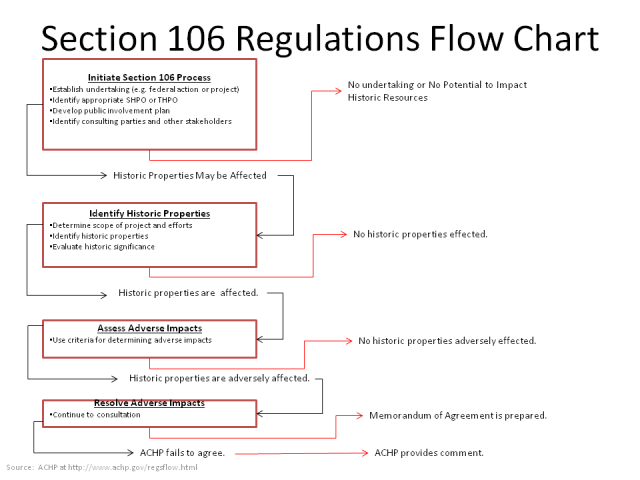
Step 1: Initiate the Section 106 Process
The federal agency determines if Section 106 applies to its project and identifies the appropriate SHPO, THPO, and other consulting parties. The agency defines the area of potential effect (APE)—the geographic area where the project could impact historic properties.
Step 2: Identify Historic Properties
Professional archaeologists and historians conduct surveys within the APE to identify cultural resources. This includes background research, field surveys, and consultation with tribes and local historical societies. Properties are evaluated against National Register criteria to determine whether they're historic.
Step 3: Assess Adverse Effects
If historic properties are present, the agency evaluates whether the project will adversely affect them. Adverse effects include physical destruction, alteration of character-defining features, or introduction of visual or audible elements that diminish integrity.
Step 4: Resolve Adverse Effects
When adverse effects are identified, the agency works with SHPO, THPO, and ACHP to develop mitigation measures. These might include project redesign, data recovery through excavation, architectural documentation, or interpretive programs.
How to Get a Property Registered on the National Register of Historic Places
Eligibility Requirements
Anybody can start the process of determining if a property or site is eligible for the National Register of Historic Places. Your SHPO will have the forms necessary to document the property, and they are an invaluable source for information. Three general criteria will be evaluated: the property's age, integrity, and significance.
To be eligible, the property must be at least 50 years old and retain the integrity of its original architecture. Significance is broad and includes evaluating whether the property is associated with historical events or people. For example, can the site provide new information through archaeological evidence of prehistoric events or culture?
The Nomination Process
The forms you obtained from your SHPO are completed to show how the property meets the criteria. These forms and supporting data are compiled into an official nomination to the ACHP requesting that the property or site be listed on the National Register of Historic Places. SHPO will review the documentation and make a recommendation if the property or site should be listed on the Register. The recommendation is forwarded to the NPS for review. If NPS agrees, the Keeper of the National Register of Historic Places will add the property or site to the National Register.
It should be noted that a property cannot be listed on the Register without the property owner's consent. However, the property can be determined to be eligible for listing. This affords the property protection in the future and will be considered a historic property for future projects or actions by federal agencies.
Why Do Cultural Resources Matter?
Balancing Development and Preservation
There are multiple reasons to protect cultural resources. Some areas of the United States work to balance historic development with new growth. Other areas value new development at the expense of local history. Areas that focus on new development generally aren't against history or culture—they assume that future generations will have the same knowledge and access as they do today. They're focused on ensuring future generations are competitive and haven't realized it's not an "either/or" choice.
Some areas are fearful of losing their past and have difficulty looking toward the necessary growth of the future. It's about finding balance. There comes a point when future generations can only learn about the past through the preservation of cultural resources and education.
Learning from the Past
You must understand where you came from to know where you're going. We've seen history become muted over time and rely on our cultural resources regulations to give our past a voice for the future. Cultural resources provide tangible connections to historical events, architectural movements, technological advances, and the diverse cultures that built America.
Career Opportunities in Cultural Resources
For students exploring careers in environmental science, cultural resources management offers meaningful opportunities to protect heritage while working on diverse projects. Professionals in this field work for federal and state agencies, consulting firms, tribal governments, and preservation organizations. Career paths include field archaeology, historic preservation planning, tribal consultation, and regulatory compliance. These positions combine outdoor fieldwork, research, community engagement, and policy implementation—offering variety that keeps the work engaging year after year.
Frequently Asked Questions
What are cultural resources in environmental science?
Cultural resources are historic properties, archaeological sites, traditional cultural places, and other evidence of past human activity that must be considered during federal environmental review. They include buildings, structures, districts, archaeological sites, and locations of cultural or religious significance. In environmental science, cultural resources represent one of five major review areas (along with biology/ecology, hazardous materials, public outreach, and permitting) that federal agencies must address under NEPA.
What is Section 106 of the National Historic Preservation Act?
Section 106 is the federal requirement that agencies consider the effects of their projects on historic properties before making final decisions. This creates a four-step process: initiate consultation, identify historic properties, assess effects, and resolve adverse effects. The Section 106 process involves consulting with State Historic Preservation Offices (SHPOs), Tribal Historic Preservation Offices (THPOs), and the Advisory Council on Historic Preservation to ensure historic properties are adequately considered.
How do I get a property listed on the National Register of Historic Places?
Contact your State Historic Preservation Office (SHPO) to obtain nomination forms. The property must be at least 50 years old, maintain its historic integrity, and demonstrate significance through association with historical events or people. Complete the forms with supporting documentation, submit them to your SHPO for review, and, if approved, have the SHPO forward the nomination to the National Park Service. The Keeper of the National Register makes the final decision. Property owner consent is required for listing.
What agencies regulate cultural resources at the federal level?
The National Park Service (NPS) and Advisory Council on Historic Preservation (ACHP) serve as primary federal authorities, with the Bureau of Indian Affairs (BIA) playing a key role in tribal consultation. Each state has a State Historic Preservation Officer (SHPO), and many tribes have Tribal Historic Preservation Officers (THPOs) who coordinate with federal agencies on projects affecting cultural resources.
What career opportunities exist in cultural resources management?
Career paths include archaeologist, architectural historian, traditional cultural property expert, cultural resources manager, historic preservation planner, and compliance specialist. These professionals work for federal and state agencies (NPS, BLM, USDA Forest Service), environmental consulting firms, tribal governments, museums, and preservation organizations. The field requires an understanding of federal regulations, fieldwork skills, research abilities, and strong communication for stakeholder consultation.
Key Takeaways
- Comprehensive Federal Requirement: Cultural resources review applies to virtually every federal project through NEPA, encompassing archaeology, historic architecture, and Native American cultural properties across all 50 states.
- Section 106 Four-Step Process: Federal agencies must initiate consultation, identify historic properties, assess adverse effects, and resolve impacts through coordination with SHPOs, THPOs, and the Advisory Council on Historic Preservation.
- Multi-Agency Coordination: The National Park Service and Advisory Council on Historic Preservation provide federal oversight, while State Historic Preservation Offices and Tribal Historic Preservation Offices serve as primary consultation partners for project review.
- National Register Protection: Properties at least 50 years old that maintain historic integrity and demonstrate significance can be listed on the National Register of Historic Places, providing recognition and consideration in federal planning processes.
- Diverse Career Pathways: Cultural resources management offers environmental science students meaningful careers in archaeology, historic preservation, tribal consultation, and regulatory compliance with federal and state agencies, consulting firms, and preservation organizations.


Interested in a career protecting America's cultural heritage? Explore environmental science degree programs that prepare you for work in archaeology, historic preservation, and cultural resources management.

- Cultural Resources in the Federal Environmental Process - March 8, 2015
- Environmental Finance: Careers, Tools & Applications - January 26, 2015
- Air Quality & Environmental Health: Indoor and Outdoor Impacts - December 21, 2014
Related Articles




Featured Article

Environmental Science Articles and Journals: Your Complete Resource Guide