
Paleontologists study fossilized remains of ancient organisms to understand Earth's evolutionary history and past climates. Most positions require a PhD, typically taking 8-12 years beyond high school. The Bureau of Labor Statistics includes paleontologists within the broader "Environmental Scientists and Specialists" category, which reports a median annual salary of $80,060 (May 2024 data).
If you've ever looked at a fossil and wondered about the creature it came from, you already understand the core fascination that drives paleontology. It's the science of piecing together Earth's ancient past through the fossilized remains of organisms that lived millions—sometimes billions—of years ago. Paleontology draws from geology, biology, chemistry, and even anthropology to answer questions about evolution, extinction, and how life on Earth has changed over time.
The revelations paleontologists uncover help us understand past climate changes, mass extinction events, and evolutionary patterns. This context lets us compare our current environment to ancient epochs, providing perspective on biodiversity loss and environmental shifts we're experiencing today.
What Does a Paleontologist Do?
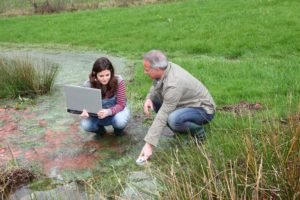
Paleontologists divide their time between fieldwork, laboratory analysis, and scholarly communication. When you're working in the field—say, excavating a site in Montana's Hell Creek Formation—you'll spend weeks documenting locations, carefully removing sediment layers, and extracting specimens without damaging them. It's physically demanding work that requires patience and precision.
Back in the lab, you'll clean and prepare fossils for study. Some paleontologists use chemical techniques to analyze fossilized samples and ancient pollen, looking for clues about past climates and ecosystems. Others examine microscopic fossils under high-powered microscopes or use CT scanning technology to see inside specimens without breaking them apart.
Research doesn't end in the field or lab. You'll write journal articles presenting your findings, apply for grants to fund future projects, and present at professional conferences. Most paleontologists also teach, leading undergraduate courses, mentoring graduate students, and serving on thesis committees. The work balances solo research time with collaborative projects and public education.
Paleontologists typically specialize in specific research areas. Micropaleontologists study microscopic fossils. Paleobotanists focus on fossil plants, algae, and fungi. Palynologists examine pollen and spores to reconstruct ancient plant communities and climates. Invertebrate paleontologists study fossils of animals without backbones—mollusks, trilobites, and ancient insects. Vertebrate paleontologists work with fossilized remains of fish, amphibians, reptiles, birds, and mammals.
Human paleontologists (paleoanthropologists) focus on prehistoric humans and our evolutionary ancestors. Taphonomists study the fossilization process itself—how organisms become fossils. Ichnologists hunt for trace fossils like footprints, burrows, and trackways. Paleoecologists use multiple lines of evidence to reconstruct entire ancient ecosystems and understand how organisms interacted with their environments.
Where Does a Paleontologist Work?
Most paleontologists hold faculty positions in geology or biology departments at colleges and universities. You'll teach courses ranging from introductory geology to specialized graduate seminars on vertebrate evolution or paleoclimate reconstruction. However, teaching represents just one aspect of academic work. Faculty positions come with expectations for original research, publication in peer-reviewed journals, grant proposal writing, graduate student mentorship, and service on department and university committees. Research and publication productivity often determine promotion and tenure decisions.
Museum positions offer another common career path with different research emphases. Natural history museums employ paleontologists to curate collections, develop exhibits, conduct research, and engage with public audiences. Museum research often focuses on specimen-based studies, collection building through field expeditions, and collaborative projects with outside researchers. The ecological perspective that many paleontologists bring helps museums tell compelling stories about ancient ecosystems and extinction events.
A smaller number of paleontologists work for government geological surveys, creating geological maps and investigating regional geological questions. Research in these settings typically emphasizes applied questions relevant to resource management, land use planning, or environmental assessment rather than purely theoretical evolutionary questions. Some consult for energy companies, helping identify petroleum-bearing rock formations by analyzing the microfossils they contain. Industry positions typically pay more than academic roles and may involve interesting technical challenges, though independent research opportunities differ from academic settings.
Fieldwork takes you outdoors to remote locations—desert badlands, arctic tundra, tropical forests—wherever fossils might be preserved in exposed rock layers. You'll work in all weather conditions, often camping for weeks at a time. The physical demands include hiking over rough terrain while carrying equipment, excavating in the sun and heat, and working in positions that strain your back and knees.
Paleontologist Salary & Compensation
The Bureau of Labor Statistics doesn't track paleontologists as a separate occupation. Instead, they're included in the broader category of "Environmental Scientists and Specialists, Including Health" (SOC code 19-2041). This category encompasses environmental scientists, climate change analysts, ecologists, and paleontologists. While this means precise salary data specific to paleontology isn't available, the BLS category provides the best available approximation for career planning.
Based on May 2024 BLS data for Environmental Scientists and Specialists, the median annual wage is $80,060. This represents the midpoint—half of workers in this category earn more, half earn less. The mean (average) annual wage is $88,640, slightly higher due to top earners in specialized fields or senior positions.
Salary ranges vary considerably by experience level. Entry-level positions (10th percentile) start around $50,130 annually. Early to mid-career professionals (25th percentile) earn approximately $62,090. Those with significant experience (75th percentile) make around $103,730, while the highest-paid positions (90th percentile) reach $134,830.
Academic salaries depend heavily on institution type, rank, and geographic location. Assistant professors at primarily undergraduate institutions typically earn approximately $55,000-$70,000, while full professors at research universities can make $90,000-$130,000 or more. These are estimates based on broader academic salary surveys, as specific paleontology salary data isn't separately tracked.
Museum positions typically pay approximately $60,000-$90,000 depending on seniority, institution size, and location. These roles often combine research with collection management and public education responsibilities. Government positions through geological surveys generally fall in the $70,000-$100,000 range, though research focus may differ from academic paleontology—often emphasizing applied work in resource mapping or environmental assessment.
Several factors affect earning potential beyond base salary. Grant funding success can supplement academic salaries through summer research stipends. Consulting work for energy companies, particularly in micropaleontology (studying microfossils for oil and gas exploration), pays considerably more on a daily rate but offers less job security. Geographic location influences compensation—positions in major metropolitan areas or resource-rich states may offer higher salaries to offset living costs.
Paleontology Jobs & Job Description
A typical paleontologist's work encompasses research design, data collection, analysis, and communication. You'll develop research questions based on gaps in existing knowledge, then design studies to address those questions. This means identifying promising field sites, securing permits and permissions, arranging logistics, and assembling field crews.
During active field seasons, you'll oversee excavation work, document stratigraphic context, collect samples, and ensure specimens are properly protected for transport. You're responsible for maintaining detailed field notes, photographing sites and specimens, and creating maps showing where each fossil was found. GPS technology and GIS software help you record precise location data.
Lab work involves specimen preparation, analysis, and interpretation. You'll remove rock matrix from fossils using everything from dental picks to acid etching, photograph and measure specimens, and compare them to existing collections. Modern techniques expand what we can learn from fossils: CT (computed tomography) scanning lets you see internal bone structures without physically cutting specimens apart; stable isotope analysis reveals information about ancient diets and climates by measuring ratios of different atomic forms in fossil material; statistical modeling helps extract patterns from large datasets of measurements across many specimens.
Communication forms a major part of the job. You'll write technical reports, prepare research articles for peer-reviewed journals, and present findings at conferences. Many paleontologists also write for popular audiences, helping the public understand new discoveries and their significance. Teaching responsibilities include preparing lectures, grading assignments, advising students, and serving on thesis committees.
Senior paleontologists and project leaders take on additional responsibilities. You'll write grant proposals to funding agencies like the National Science Foundation, manage project budgets, supervise field crews and graduate students, ensure compliance with regulations governing fossil collection, and coordinate with land management agencies. You might also review manuscripts for journals, serve on professional organization committees, and mentor early-career scientists.
What Is the Job Demand for Paleontologists?
Employment for environmental scientists and specialists (the broader BLS category that includes paleontologists) is projected to grow 6% from 2022 to 2032, according to Bureau of Labor Statistics projections. This translates to approximately 4,800 new positions over the decade, with about 6,900 total job openings annually when including replacement needs as current professionals retire or change careers.
For paleontologists specifically, the outlook is more conservative. According to the Paleontological Research Institution, fewer than 100 dedicated paleontology positions typically become available annually in the United States. Competition for academic positions is particularly intense, with dozens of qualified PhD candidates often applying for each tenure-track faculty opening. This makes paleontology one of the most competitive specializations within environmental science.
Growth in paleontology employment comes primarily from museum expansions, university program development in underserved regions, and increased research interest in paleoclimate studies relevant to understanding modern climate change. Some opportunities arise in consulting for energy companies, though these positions typically require expertise in micropaleontology (studying microscopic fossils to identify petroleum-bearing rock formations) rather than vertebrate or plant paleontology.
The specialized nature of the field means you'll need geographic flexibility and should prepare for potentially taking multiple postdoctoral positions before securing a permanent role. Many paleontologists work in related fields like geology, museum education, or science communication while continuing their paleontological research through collaborations or independent projects.
How Do I Get a Paleontology Degree?
A PhD is necessary for most paleontological careers, particularly in academia and museum research positions. Plan on 8-12 years of postsecondary education: four years for a bachelor's degree, 2-3 years for a master's degree (though some programs let you proceed directly to a PhD), and 4-6 years for doctoral work. Many newly-minted PhDs then complete 1-3 years of postdoctoral research—conducting research under established scientists while building publication records—before securing permanent positions.
Your undergraduate preparation should include a double major or a major with extensive coursework in both geology and biology. You'll need mineralogy, stratigraphy, sedimentology, and structural geology from the Earth science side. From biology, take evolution, ecology, comparative anatomy, and genetics. Don't skip chemistry, physics, calculus, and statistics—quantitative skills are essential for modern paleontological research.
Field and laboratory experience matter as much as coursework. Volunteer at natural history museums, join paleontology field schools, or participate in your university's fossil club. Undergraduate research experiences help you develop practical skills while building relationships with potential graduate advisors. Many undergraduates work as teaching assistants or museum volunteers to gain relevant experience.
Graduate school selection depends on your research interests. Look for advisors actively working in your area of specialization who have strong publication records and a history of placing students in good positions. Consider program size, available facilities, field work opportunities, and funding packages. Most PhD programs provide tuition waivers plus stipends for teaching or research assistantships.
The path requires significant financial investment and time commitment. Understanding the competitive nature of the field helps you make realistic decisions about pursuing paleontology. Resources like environmental science scholarships can help fund undergraduate and graduate education, reducing debt burden as you work toward your career goals.
Related Degree Options for Paleontology
Skills Required for Paleontologists
Successful paleontologists combine field skills, laboratory techniques, and analytical abilities. You'll need physical stamina for fieldwork—hiking long distances over rough terrain, working in uncomfortable positions, lifting heavy equipment, and tolerating extreme weather conditions. Manual dexterity helps when extracting delicate fossils or preparing tiny specimens under a microscope.
Analytical thinking and problem-solving skills are fundamental. Fossils rarely tell their story directly—you'll interpret fragmentary evidence, compare specimens across collections, and build arguments about ancient organisms' biology and ecology. Strong quantitative skills help you apply statistical methods, create computer models, and analyze large datasets.
Communication skills matter more than many students expect. You'll write grant proposals competing for limited funding, publish research articles in peer-reviewed journals, teach undergraduate and graduate courses, present findings at conferences, and often engage with public audiences through museum programs or media interviews. Clear writing and public speaking abilities help you share your research effectively.
Collaboration and patience prove essential. Fieldwork requires coordinating teams, often in isolated locations. Research projects span years or decades—you might work on a single fossil site for your entire career. Patience helps when you spend weeks in the field without finding anything significant, or when grant proposals get rejected despite months of preparation.
Technical skills with modern research tools give you competitive advantages. Geographic Information Systems (GIS) help you map fossil sites and analyze spatial patterns. CT scanning and 3D modeling let you examine specimens non-destructively. Statistical software packages enable sophisticated data analysis. Programming skills help you develop custom analysis tools or work with large paleoclimate datasets.
Frequently Asked Questions
What does a paleontologist do?
Paleontologists study fossilized remains of ancient organisms to understand evolution, extinction events, and past environments. They divide their time between fieldwork (excavating fossils from rock formations), laboratory analysis (preparing and studying specimens), and scholarly communication (writing research papers, teaching courses, and presenting at conferences).
How much do paleontologists make?
Paleontologists fall under the broader BLS category of Environmental Scientists, which reports a median annual salary of $80,060 as of May 2024. Academic positions typically range from $55,000-$130,000 depending on institution type and rank. Museum positions generally pay $60,000-$90,000, while government roles often fall in the $70,000-$100,000 range.
How long does it take to become a paleontologist?
Most paleontology careers require a PhD, which takes 8-12 years beyond high school. This includes four years for a bachelor's degree (typically in geology and biology), 2-3 years for a master's degree, and 4-6 years for doctoral work. Many then complete 1-3 years of postdoctoral research before securing permanent positions.
Do paleontologists only study dinosaurs?
No. While dinosaur paleontology gets the most public attention, paleontologists study all fossilized life forms, including plants, insects, marine invertebrates, fish, mammals, and microscopic organisms. Many specialize in areas like paleobotany (fossil plants), micropaleontology (microscopic fossils), or palynology (ancient pollen and spores).
Can you become a paleontologist without a PhD?
Very few paleontology positions are available without a PhD. Some technician or preparator roles in museums require only a bachelor's or master's degree, focusing on fossil preparation rather than independent research. Most research-oriented positions in universities, museums, and government agencies require doctoral-level training.
What Kind of Societies and Professional Organizations Do Paleontologists Have?
- The Palaeontological Association publishes academic journals, newsletters, and field guides, sponsors an annual meeting and field excursions, provides Web resources, and funds grants and awards. It also hosts career information.
- Founded in 1940, The Society of Vertebrate Paleontology provides a global forum for vertebrate paleontologists through publications, annual meetings, and an email list. It accepts a wide variety of professionals, including science artists and writers.
Key Takeaways
- Advanced Education Required: Most paleontology positions require a PhD, typically taking 8-12 years beyond high school, including bachelor's, master's, and doctoral study. Strong foundations in both geology and biology are essential.
- Specialized Field: Fewer than 100 paleontology positions become available annually in the United States, making it one of the most competitive environmental science careers. Geographic flexibility and persistence are necessary.
- Academic Focus: Most paleontologists work in university settings, combining teaching responsibilities with research rather than conducting full-time fieldwork. Museum and government positions provide alternative career paths.
- Broad Scientific Foundation: Successful paleontologists need expertise across multiple disciplines, including geology, biology, chemistry, and statistics. Modern research increasingly requires computational and quantitative skills.
- Realistic Salary Expectations: Environmental scientists (the broader BLS category including paleontologists) earn a median of $80,060 annually, with academic salaries varying significantly by institution type and rank.
Passionate about Earth's ancient past and evolutionary history? Explore environmental science programs that offer strong geology and biology foundations to prepare you for graduate study in paleontology.

2024 US Bureau of Labor Statistics salary and job growth figures cited in this article refer to "Environmental Scientists and Specialists, Including Health" (SOC code 19-2041), the broader occupational category that includes paleontologists, environmental scientists, climate change analysts, and related professionals. The BLS does not track paleontologists as a separate occupation. All salary and employment projection data reflect national averages, not school-specific information. Conditions in your area may vary. Data accessed January 2026. View BLS Occupational Outlook Handbook.