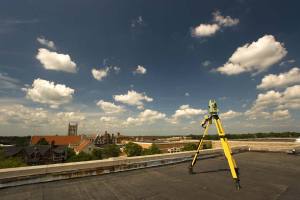


A statistician analyzes large datasets to identify trends and produce actionable reports across diverse industries. In environmental science, statisticians examine pollution patterns, climate data, and ecological trends to support evidence-based policy decisions. According to the Bureau of Labor Statistics, statisticians (SOC 15-2041) earned a median annual wage of $103,300 as of May 2024, with strong projected employment growth of 9% from 2024 to 2034—three times the average across all occupations.
Statistics form the mathematical backbone of environmental science research. When climate scientists track global temperature changes, pollution analysts monitor air quality trends, or conservation biologists assess wildlife populations, statisticians transform raw numbers into meaningful insights that drive environmental policy and protection efforts.
The field combines rigorous mathematical training with practical problem-solving across sectors ranging from federal environmental agencies to private consulting firms. Whether you're analyzing water quality data for the EPA, modeling species migration patterns, or forecasting climate scenarios, statistical expertise provides the analytical foundation for understanding our changing planet.
What Does a Statistician Do?
Statisticians serve as data translators, converting massive datasets into clear findings that inform decision-making. In environmental applications, this work directly impacts how we understand and respond to ecological challenges. A statistician might spend their morning analyzing ten years of river pollution data to identify contamination sources, then spend the afternoon building predictive models for drought risk assessment.
The work begins with data acquisition and assessment. You'll evaluate existing studies, design new data collection methodologies, or assess the quality and reliability of datasets from various sources. In environmental contexts, this might involve reviewing air quality monitoring stations, satellite imagery datasets, or biodiversity survey results to ensure the information meets scientific standards.
Statistical methodology application forms the core of the role. You'll select and apply appropriate statistical techniques to complex datasets, whether that's regression analysis for pollution trend identification, spatial statistics for habitat mapping, or time series analysis for climate pattern detection. Modern statisticians increasingly work as environmental data analysts, combining traditional statistical methods with contemporary data science tools.
Communication and consultation represent critical responsibilities. You'll translate technical findings into accessible reports for stakeholders, from policymakers needing clear recommendations to the public requiring understandable explanations of environmental risks. Many statisticians work as consultants, advising decision-makers on how to interpret complex data or designing studies that will yield meaningful results.
The role increasingly demands technological proficiency. Beyond traditional statistical software, environmental statisticians often use specialized tools, including SPSS for survey analysis, Microsoft Access for database management, and Geographic Information Systems (GIS) for spatial data visualization. The ability to program in R or Python has become essential for automating analyses and creating reproducible research workflows.
Where Do Statisticians Work?
Environmental applications drive substantial statistical employment. Federal agencies represent major employers, accounting for approximately 17% of all statistician positions according to current BLS data. The Environmental Protection Agency uses statisticians to analyze pollution trends and assess cleanup effectiveness, NOAA employs them for climate modeling and fisheries management, and the U.S. Geological Survey relies on statistical expertise for natural resource assessment. The U.S. Census Bureau, Bureau of Labor Statistics, and Bureau of Economic Analysis also hire significant numbers of statistical professionals.
Scientific research and development services form another critical sector, accounting for approximately 14% of statistical employment. These contract researchers work on specific projects—sometimes for environmental nonprofits, other times for government agencies requiring independent analysis. A statistician in this sector might spend six months evaluating pharmaceutical trial data for FDA approval, then transition to a year-long contract analyzing wetland restoration success for a conservation organization. This sector employs approximately 5,460 statisticians nationally, making it the single largest private-sector employer of statistical professionals.
Environmental consulting firms increasingly seek statistical expertise as companies navigate complex environmental regulations. You might work with a firm helping industrial clients model their pollution impacts, assess remediation strategies, or predict regulatory compliance costs. These positions blend environmental science knowledge with business application, requiring both technical accuracy and client communication skills.
Healthcare and social assistance sectors employ roughly 8% of statisticians, working on public health surveillance, clinical trial design, epidemiological studies, and health outcomes research. This sector has grown substantially since the pandemic, reflecting increased recognition of data-driven decision-making in public health.
Academic institutions employ approximately 6% of statisticians in dual roles—teaching future analysts while conducting research. State and federal education departments use statistical analysis for resource allocation, budget planning, and program effectiveness assessment. These positions offer stable employment with strong benefits packages and research autonomy, though typically at lower compensation than private sector roles.
Computer systems design and related services, while employing only about 4% of statisticians, offer the highest median wages at $136,340 annually. These technology-focused roles increasingly intersect with environmental applications through climate data platforms, environmental monitoring systems, and sustainability analytics software.
Professional relationships with GIS technicians are increasingly common, particularly in environmental applications where spatial statistics help identify pollution hotspots, track species distributions, or model climate change impacts across landscapes.
What Is the Average Statistician Salary?
The Bureau of Labor Statistics reported that as of May 2024, statisticians (classified under SOC 15-2041) earned a median annual wage of $103,300. This represents significantly above-average compensation, reflecting the specialized mathematical training and analytical expertise the role requires. The median wage has grown from $110,860 in 2020, though this earlier figure combined both mathematicians and statisticians under a broader classification.
Salary ranges vary considerably based on experience, education, and sector. The lowest 10% of statisticians earned less than $60,390 annually, typically representing entry-level positions or roles in smaller organizations or academic settings. The highest 10% earned more than $170,700, usually held by senior statisticians in technology sectors, pharmaceutical research, or federal positions requiring security clearances. The mean annual wage across all statisticians stood at $112,330 in May 2024.
Industry sector significantly influences compensation. Computer systems design and related services offered the highest median pay at $136,340, followed by federal government positions at $128,940. Research and development in physical, engineering, and life sciences provided median wages of $125,710. Healthcare and social assistance sectors offered $99,540, while state colleges and universities typically provided lower compensation at $81,920, but with strong benefits packages and research autonomy.
Geographic location creates additional variation. Metropolitan areas with significant research institutions, government agencies, or technology sectors typically offer premium salaries. Environmental statisticians working in regions with active environmental consulting markets or major federal research facilities often see elevated compensation due to specialized demand and cost-of-living adjustments.
Educational attainment affects earning potential substantially. While entry-level positions with bachelor's degrees provide solid starting salaries in the $60,000-$75,000 range, master's degree holders typically command 20-30% higher compensation. PhDs can access senior research positions and university faculty roles with the highest earning potential, though these positions require longer educational investment and are more competitive.
What Is the Job Demand for Statisticians?
Demand for statisticians remains strong, with the Bureau of Labor Statistics projecting 9% employment growth from 2024 to 2034. This represents three times the average growth rate of 3% across all occupations, classifying statistics as a field growing "much faster than average." The BLS projects approximately 2,700 new statistician positions will be created during this decade, with roughly 2,200 annual job openings when accounting for replacement needs from retirements and career transitions.
This growth represents a moderation from the explosive 33% projection for the 2020-2030 period, reflecting both the field's maturation and more conservative economic forecasting. However, 9% growth still positions statistics among the stronger career prospects available, particularly when compared to many technical fields facing automation pressures or declining demand.
The continued expansion of data collection and analysis capabilities drives ongoing demand. Organizations across every sector now collect massive amounts of information through digital transactions, sensor networks, and online interactions, but raw data alone provides little value. Statistical expertise transforms these datasets into actionable intelligence, whether that's predicting consumer behavior, optimizing supply chains, or—in environmental applications—forecasting climate impacts or tracking ecosystem health.
Environmental applications specifically contribute to sustained demand. As climate change intensifies, governments and organizations need sophisticated statistical modeling to predict impacts, evaluate intervention effectiveness, and allocate adaptation resources. The transition to renewable energy requires statistical analysis of generation patterns, grid stability, and storage optimization. Conservation biology increasingly relies on advanced statistical methods to assess species vulnerability and prioritize protection efforts.
The COVID-19 pandemic highlighted the critical importance of statistical expertise for public health response, epidemiological modeling, and policy development. This visibility has strengthened institutional support for expanding statistical capacity across government and research sectors, particularly in areas related to environmental health and disease ecology.
Technology continues to create new applications for statistical methods. Machine learning and artificial intelligence fundamentally depend on statistical principles, even as they automate some traditional statistical tasks. The increasing integration of IoT sensors in environmental monitoring generates continuous data streams requiring real-time statistical analysis—creating entirely new categories of statistical employment that didn't exist a decade ago.
Essential Skills & Software
A strong mathematical foundation forms the bedrock of statistical work. You'll need a thorough understanding of probability theory, calculus, linear algebra, and statistical inference. Most importantly, you must grasp which statistical methods apply to which types of questions—knowing when to use regression versus ANOVA versus nonparametric tests requires both theoretical knowledge and practical judgment developed through experience.
Programming ability has evolved from optional to essential. R remains the statistical computing standard, offering unmatched analytical capabilities and extensive package libraries for specialized applications. Python provides versatility beyond pure statistics, enabling data manipulation, web scraping, and machine learning integration. SQL database querying skills allow you to extract and manipulate data from large institutional databases. Many environmental positions also require some familiarity with specialized software like SPSS for survey analysis or SAS for large-scale data processing.
Data visualization represents a distinct skill set beyond basic analysis. Creating clear, accurate graphics that communicate complex findings to non-technical audiences requires understanding both statistical principles and human perception. Tools like ggplot2 in R, matplotlib in Python, or Tableau for interactive dashboards each serve different communication needs.
Domain expertise increasingly distinguishes good statisticians from exceptional ones. In environmental applications, understanding ecosystem dynamics, pollution chemistry, or climate systems allows you to ask better questions, recognize data anomalies, and provide more valuable interpretations. While you needn't become an environmental scientist, familiarity with the field in which you apply statistics dramatically improves your contribution.
Communication skills often prove more valuable than advanced mathematical knowledge. You must translate technical findings into clear language for diverse audiences—explaining uncertainty to policymakers, presenting limitations to clients, or teaching statistical concepts to collaborators from other disciplines. Written communication for reports and journal articles requires particular attention in scientific and government sectors.
The connection to mathematics as a foundational discipline cannot be overstated—statistics builds directly on mathematical theory, making strong mathematical training essential for statistical career success.
What Are the Education Requirements to Become a Statistician?
The educational pathway to statistical careers requires strong mathematical preparation beginning in high school. You'll need solid grades in algebra, geometry, trigonometry, and preferably calculus. Computer science or programming courses provide valuable preparation for the computational aspects of modern statistics. If you're already considering environmental applications, coursework in biology, chemistry, or earth science establishes domain knowledge that will serve you throughout your career.
Bachelor's Degree Options
Multiple undergraduate pathways lead to statistical careers, each offering distinct advantages. A dedicated statistics degree provides the most direct route, emphasizing probability theory, statistical inference, experimental design, and computational methods. Mathematics degrees offer similar preparation with stronger theoretical grounding but sometimes less applied experience.
For students specifically interested in environmental applications, an environmental science or environmental engineering major combined with a mathematics or statistics minor creates excellent preparation. This approach provides deep understanding of environmental systems while developing the quantitative skills needed for analytical work. You'll understand what the data represents—whether that's parts per million of atmospheric carbon dioxide or population density estimates for threatened species—which significantly enhances your analytical capabilities.
Related degrees in physics, computer science, economics, or any engineering discipline typically include substantial statistical coursework. These paths can lead to statistical careers, particularly if you supplement your major with additional statistics courses as electives. Data science programs have emerged as popular alternatives, blending statistical theory with computer science and machine learning—though they may offer less depth in traditional statistical methods.
Internship and research experience during undergraduate studies provide crucial practical experience. Look for opportunities with faculty conducting statistical research, government agencies needing data analysis support, or companies with analytics divisions. These experiences help you determine which statistical applications interest you most while building the practical skills that make you competitive for employment.
Master's Degree Programs
Most professional statistical positions require or strongly prefer master's degree preparation. A Master of Science in Statistics typically includes two years of advanced coursework in statistical theory, regression analysis, experimental design, categorical data analysis, time series analysis, and computational statistics. Many programs offer specialization tracks in areas like biostatistics, environmental statistics, or data analytics.
The curriculum usually balances theoretical understanding with applied projects. You might complete a thesis involving original statistical research, a capstone project applying statistical methods to real-world problems, or an internship with a research organization or company. These experiences provide portfolio material demonstrating your capabilities to potential employers.
Students with non-statistics undergraduate degrees can still pursue statistical master's programs, though they typically need to complete prerequisite coursework in calculus, linear algebra, and introductory statistics. Some programs offer "bridge" courses during the summer before the program begins, while others require prerequisites be completed beforehand.
The current high demand for statistical expertise means that bachelor's degree holders shouldn't have difficulty finding entry-level positions. However, advancement to senior roles, leadership positions, or specialized research positions almost universally requires graduate education. Consider starting your career with a bachelor's degree, then pursuing a master's degree part-time once you've identified your specific interests and career goals.
When You Need a PhD
Doctoral education serves specific career paths rather than representing a general requirement for statistical work. If you aim for university faculty positions, leading research divisions at major institutions, or developing new statistical methodologies, a PhD provides essential preparation. The degree typically requires four to six years beyond the bachelor's degree, including advanced coursework, comprehensive examinations, and original research culminating in a dissertation.
Government research laboratories, particularly those focused on environmental monitoring and climate science, sometimes prefer or require PhDs for senior scientist positions. However, many accomplished government statisticians build successful careers with master's degrees, particularly in applied rather than research-focused roles.
The private sector rarely requires PhDs except in specialized research and development contexts. Companies generally prefer the practical experience and broader skill sets that master's degree holders develop over the theoretical depth that PhD programs emphasize. If you enjoy applied problem-solving more than methodological innovation, you likely don't need doctoral training.
Other Degrees Related to Statistics
How to Become a Statistician
The path to statistical careers follows a relatively structured progression, though individual timelines and exact routes vary based on your starting point and career goals.
Begin with strong mathematical preparation in high school. Take the most advanced mathematics courses available, including AP Statistics and AP Calculus if offered. Develop basic programming skills through computer science courses or self-study. Consider summer programs or online courses in data analysis to explore whether statistical work appeals to you.
Choose an undergraduate program that aligns with your interests. Apply to colleges with strong statistics, mathematics, or data science programs if you're confident in your direction, or consider schools with solid environmental science programs if you prefer to maintain flexibility while building quantitative skills. During your first year, take introductory statistics and calculus courses to confirm your interest before declaring a major.
Build practical experience throughout your undergraduate years. Seek research assistant positions with faculty, apply for summer internships with government agencies or private companies, and consider participating in data analysis competitions or collaborative research projects. These experiences distinguish your applications for both employment and graduate programs while helping you discover which statistical applications interest you most.
For students targeting direct employment after a bachelor's degree, focus your senior year on advanced applied courses, completing an internship if you haven't already, and developing a portfolio of projects demonstrating your capabilities. Many entry-level positions require only strong foundational skills and the ability to learn on the job.
If pursuing graduate education, typically the more common path is to research programs during your junior year. Most statistics master's programs admit students in fall cohorts, with applications due between December and February of your senior year. Prepare for the GRE if required, secure recommendation letters from faculty who know your work well, and write a clear statement of purpose explaining your interests and goals.
During your master's program, pursue internship opportunities between academic years. Many students complete summer internships after their first year of graduate study, gaining practical experience that improves their thesis or capstone projects and makes them more competitive for post-graduation employment. Use your second year to develop specialization in areas that interest you most, whether environmental applications, biostatistics, survey methodology, or other focuses.
Entry-level positions after master's completion typically involve working as part of a team, implementing statistical analyses designed by senior statisticians, and gradually taking on more independent responsibilities. Expect to spend several years building expertise before moving into roles where you independently design studies, consult with clients, or supervise other analysts.
Career Advancement Opportunities
Statistical careers offer multiple advancement pathways depending on your interests and strengths. Understanding these trajectories helps you make strategic decisions about skill development and career moves.
The technical specialist track emphasizes deepening statistical expertise. You progress from junior statistician implementing standard analyses to senior statistician designing complex studies and selecting appropriate methodologies, and potentially to principal statistician or statistical fellow recognized as an organizational expert. This path rewards those who enjoy the intellectual challenges of statistical work itself and want to remain deeply involved in analysis rather than transitioning to management.
The management track involves moving from statistical work into team leadership and organizational decision-making. You might advance from team member to project lead, coordinating small groups, then to statistical manager, overseeing multiple projects and staff, and potentially to director of analytics or chief data officer, setting organizational strategy. This trajectory requires developing leadership, communication, and business acumen beyond statistical skills.
Consulting represents another advancement direction. After building expertise and reputation in a particular application area—environmental analysis, healthcare, finance, or others—many statisticians transition to independent consulting. You might start consulting part-time while employed, then transition to full-time practice once you've established a client base. This path offers autonomy and potentially higher earnings but requires business development skills and comfort with income variability.
Industry mobility serves as a form of advancement itself. Environmental statisticians can transition into pharmaceutical biostatistics, financial risk analysis, technology companies, or other sectors. Each move typically involves salary increases and opportunities to apply your skills to new domains. The fundamental statistical expertise remains valuable across contexts, though you'll need to develop new domain knowledge with each transition.
Many statisticians pursue professional certifications to demonstrate expertise and enhance credentials. The American Statistical Association offers several certification programs for different specializations. These credentials particularly benefit those in consulting or seeking to establish authority in new domains.
Academic advancement follows its own trajectory, from postdoctoral researcher to assistant professor, associate professor, and full professor. This path emphasizes research productivity, grant acquisition, and teaching excellence, offering intellectual freedom but typically lower compensation than private sector senior roles.
What Kind Of Societies and Professional Organizations Do Statisticians Have?
Statistics has maintained professional organizations since the Enlightenment era, reflecting the field's long history and importance across societies. These organizations provide continuing education, networking opportunities, career resources, and venues for sharing new methodological developments.
- American Statistical Association: Despite its name, the ASA represents the world's largest community of statisticians with members globally. Founded in 1839, it's the second-oldest professional association in the United States. The organization publishes several prestigious journals, hosts annual conferences bringing together thousands of practitioners and researchers, and advocates for statistical education and practice. They also administer "This Is Statistics," an outreach program helping students and educators understand statistical career opportunities and applications.
- Royal Statistical Society: Based in the United Kingdom, the RSS represents the oldest statistical society, founded in 1834. While centered in Britain, it maintains international membership and influence. The organization focuses on promoting statistical excellence, raising awareness of statistics' importance in society, and maintaining professional standards. They offer several grades of membership reflecting different career stages and publish influential journals covering both theoretical and applied statistics.
Frequently Asked Questions
What software do statisticians use?
Most statisticians work primarily in R or Python, with R remaining the statistical standard for its comprehensive analysis libraries and reproducibility features. SPSS sees widespread use in social science research and survey analysis, while SAS dominates the pharmaceutical and healthcare sectors due to regulatory acceptance. Many environmental statisticians also use Geographic Information Systems (GIS) software for spatial analysis, and increasingly employ data visualization tools like Tableau or PowerBI for creating stakeholder-facing dashboards. SQL knowledge is nearly universal for extracting data from databases.
Do I need a PhD to become a statistician?
No—most practicing statisticians hold master's degrees rather than doctorates. PhDs serve specific career paths, including university faculty positions, leading research divisions at major institutions, or developing new statistical methodologies. If you're interested in applied statistical work, solving practical problems for government agencies, private companies, or consulting firms, a master's degree provides sufficient preparation and a better return on educational investment. Bachelor's degrees can secure entry-level positions in the current high-demand environment, though advancement typically requires graduate education.
What's the difference between a statistician and a data scientist?
The boundaries blur considerably, but generally statisticians emphasize probabilistic inference, uncertainty quantification, and hypothesis testing using established mathematical frameworks, while data scientists focus more on prediction, pattern discovery, and machine learning using computational approaches. Statisticians typically have deeper training in mathematical theory and experimental design, while data scientists often have stronger programming skills and experience with large-scale data infrastructure. In practice, many positions require skills from both domains, and the title often reflects organizational culture more than fundamental job differences.
Can I work as a statistician with just a bachelor's degree?
Yes, particularly in the current strong job market. Entry-level positions exist across industries for bachelor's degree holders with strong statistical and programming skills. You'll typically work as part of a team implementing analyses designed by senior statisticians, gradually taking on more responsibility as you gain experience. However, advancement to senior roles, independent consulting, or leadership positions almost universally requires a master's degree. Many statisticians start their careers after a bachelor's degree, then pursue master's degrees part-time once they've identified their specific interests and career goals.
What industries hire the most statisticians?
The federal government represents the largest single employer at approximately 17% of statistical employment, with major concentrations at the Census Bureau, Bureau of Labor Statistics, EPA, and economic analysis agencies. Scientific research services account for about 14%, employing statisticians on a contract basis for specific projects. Healthcare and social assistance employ roughly 8% in public health and clinical research roles. Education sectors employ about 6% in teaching and institutional research positions. Computer systems design, while employing only 4%, offers the highest median wages at $136,340. However, statistical expertise finds applications across nearly every industry, from finance and pharmaceuticals to manufacturing, retail, environmental consulting, and technology.
Key Takeaways
- Strong Job Growth: With 9% projected growth from 2024 to 2034—three times the average across all occupations—statisticians face robust job markets driven by expanding data analysis needs across industries and growing environmental modeling demands.
- Competitive Compensation: The median statistician salary of $103,300 (as of May 2024) reflects specialized mathematical training and analytical expertise, with the highest earners exceeding $170,700 in technology, pharmaceutical research, and federal government positions.
- Flexible Educational Pathways: While master's degrees are preferred for most positions, bachelor's degree holders can secure entry-level roles in the current strong job market, with PhDs required only for university faculty positions and advanced methodological research roles.
- Environmental Applications Expanding: Federal environmental agencies employ 17% of all statisticians, with climate change, conservation biology, and environmental policy increasingly depending on sophisticated statistical analysis to support evidence-based decision-making.
- Technical Skills Evolution: Modern statisticians must combine traditional mathematical statistics with programming proficiency in R or Python, database management, data visualization, and often specialized tools like GIS for spatial analysis or machine learning frameworks for predictive modeling.
Ready to start your statistics career in environmental science? Explore degree programs that combine mathematical rigor with environmental applications and prepare you for this high-growth field.

2024 US Bureau of Labor Statistics salary figures and employment projections for statisticians (SOC 15-2041) reflect national data, not school-specific information. Conditions in your area may vary. Data accessed January 2026.